


 Greenbelt, MD – Measurements from NASA’s Transiting Exoplanet Survey Satellite (TESS) have enabled astronomers to greatly improve their understanding of the bizarre environment of KELT-9 b, one of the hottest planets known.
“The weirdness factor is high with KELT-9 b,” said John Ahlers, an astronomer at Universities Space Research Association in Columbia, Maryland, and NASA’s Goddard Space Flight Center in Greenbelt, Maryland. “It’s a giant planet in a very close, nearly polar orbit around a rapidly rotating star, and these features complicate our ability to understand the star and its effects on the planet.”
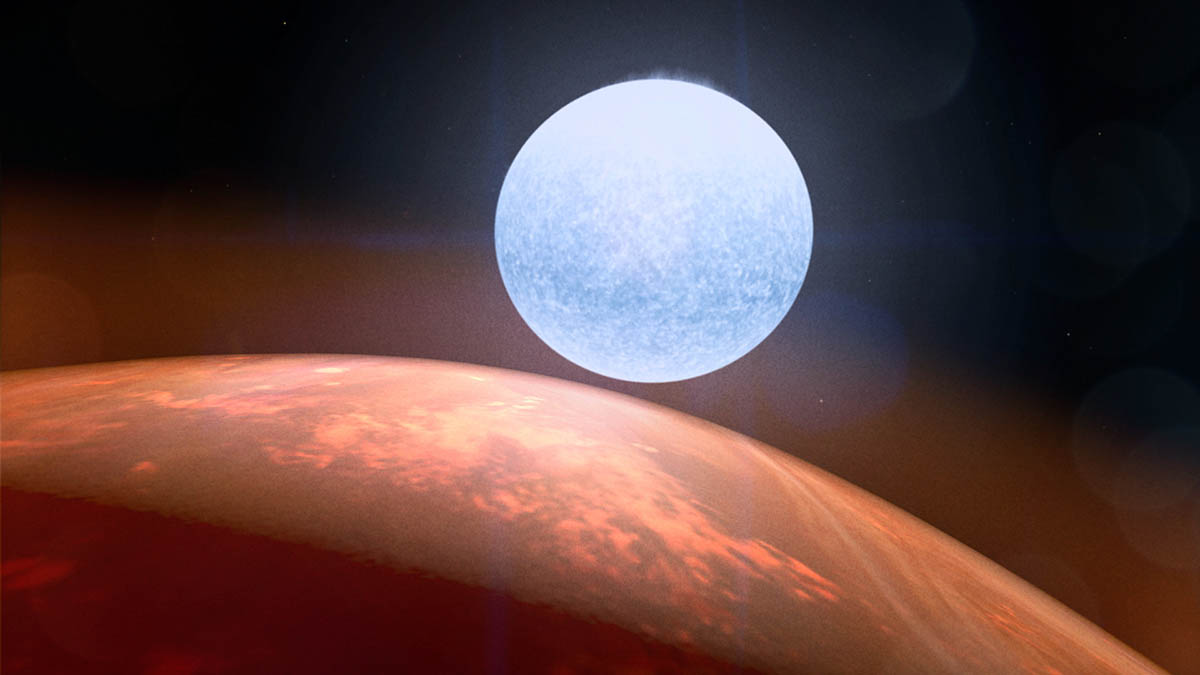
This illustration shows how planet KELT-9 b sees its host star. Over the course of a single orbit, the planet twice experiences cycles of heating and cooling caused by the star’s unusual pattern of surface temperatures. Between the star’s hot poles and cool equator, temperatures vary by about 1,500 F (800 C). (NASA’s Goddard Space Flight Center/Chris Smith (USRA))
The new findings appear in a paper led by Ahlers published on June 5th in The Astronomical Journal.
Located about 670 light-years away in the constellation Cygnus, KELT-9 b was discovered in 2017 because the planet passed in front of its star for a part of each orbit, an event called a transit. Transits regularly dim the star’s light by a small but detectable amount.
The transits of KELT-9 b were first observed by the KELT transit survey, a project that collected observations from two robotic telescopes located in Arizona and South Africa.
Between July 18th and September 11th, 2019, as part of the mission’s yearlong campaign to observe the northern sky, TESS observed 27 transits of KELT-9 b, taking measurements every two minutes. These observations allowed the team to model the system’s unusual star and its impact on the planet.
KELT-9 b is a gas giant world about 1.8 times bigger than Jupiter, with 2.9 times its mass. Tidal forces have locked its rotation so the same side always faces its star. The planet swings around its star in just 36 hours on an orbit that carries it almost directly above both of the star’s poles.
KELT-9 b receives 44,000 times more energy from its star than Earth does from the Sun. This makes the planet’s dayside temperature around 7,800 degrees Fahrenheit (4,300 C), hotter than the surfaces of some stars. This intense heating also causes the planet’s atmosphere to stream away into space.
Its host star is an oddity, too. It’s about twice the size of the Sun and averages about 56 percent hotter. But it spins 38 times faster than the Sun, completing a full rotation in just 16 hours. Its rapid spin distorts the star’s shape, flattening it at the poles and widening its midsection. This causes the star’s poles to heat up and brighten while its equatorial region cools and dims — a phenomenon called gravity darkening. The result is a temperature difference across the star’s surface of almost 1,500 F (800 C).
With each orbit, KELT-9 b twice experiences the full range of stellar temperatures, producing what amounts to a peculiar seasonal sequence. The planet experiences “summer” when it swings over each hot pole and “winter” when it passes over the star’s cooler midsection. So KELT-9 b experiences two summers and two winters every year, with each season about nine hours.
“It’s really intriguing to think about how the star’s temperature gradient impacts the planet,” said Goddard’s Knicole Colón, a co-author of the paper. “The varying levels of energy received from its star likely produce an extremely dynamic atmosphere.”
KELT-9 b’s polar orbit around its flattened star produces distinctly lopsided transits. The planet begins its transit near the star’s bright poles and then blocks less and less light as it travels over the star’s dimmer equator. This asymmetry provides clues to the temperature and brightness changes across the star’s surface, and they permitted the team to reconstruct the star’s out-of-round shape, how it’s oriented in space, its range of surface temperatures, and other factors impacting the planet.
“Of the planetary systems that we’ve studied via gravity darkening, the effects on KELT-9 b are by far the most spectacular,” said Jason Barnes, a professor of physics at the University of Idaho and a co-author of the paper. “This work goes a long way toward unifying gravity darkening with other techniques that measure planetary alignment, which in the end we hope will tease out secrets about the formation and evolutionary history of planets around high-mass stars.”
TESS is a NASA Astrophysics Explorer mission led and operated by MIT in Cambridge, Massachusetts, and managed by NASA’s Goddard Space Flight Center. Additional partners include Northrop Grumman, based in Falls Church, Virginia; NASA’s Ames Research Center in California’s Silicon Valley; the Harvard-Smithsonian Center for Astrophysics in Cambridge, Massachusetts; MIT’s Lincoln Laboratory; and the Space Telescope Science Institute in Baltimore. More than a dozen universities, research institutes and observatories worldwide are participants in the mission.
Related Stories
Sections
Topics
Astronomers, Atmosphere, Cambridge MA, Constellation Cygnus, earth, Greenbelt MD, Jupiter, MIT, NASA, NASA’s Ames Research Center, NASA’s Goddard Space Flight Center, NASA’s TESS Satellite, NASA’s Transiting Exoplanet Survey Satellite, National Aeronautics and Space Administration, Planet, Star, Sun







