

Abstract
BACKGROUND AND OBJECTIVES: Insights from behavioral economics suggests that the effectiveness of health messages depends on how a message is framed. Parent preferences for smoking cessation messaging has not been studied in pediatrics, warranting further exploration to maximize benefit. We sought to assess parents’ perceptions regarding the relative importance of distinct message framings to promote their smoking cessation.
METHODS: We conducted a cross-sectional discrete choice experiment in which parent smokers rated the relative importance of 26 messages designed to encourage them to begin cessation treatment. Messages varied on who was featured (child, parent, or family), whether the message was gain or loss framed, and what outcome was included (general health, cancer, respiratory illnesses, child becoming a smoker, or financial impact). The participants were 180 parent smokers attending primary care visits with their children at 4 diverse pediatric sites. The main outcome was the importance of smoking cessation messages based on who was featured, gain or loss framing, and the outcome emphasized.
RESULTS: Parent smokers highly prioritized cessation messages emphasizing the impact of quitting smoking on their child versus parent or family. Messages focusing on respiratory illness, cancer, or general health outcomes consistently ranked highest, whereas messages focused on the financial benefits of quitting ranked lowest. Gain versus loss framing did not meaningfully influence rankings.
CONCLUSIONS: Parent smokers identified smoking cessation messages that emphasized the impact on their child, with outcomes focused on respiratory health, cancer, or general health, as most important. The clinical impact of these messages should be tested in future research.
- CHOP —
- Children’s Hospital of Philadelphia
- CI —
- confidence interval
- DCE —
- discrete choice experiment
- e-cigarette —
- electronic cigarette
- SHS —
- secondhand smoke
What’s Known on This Subject:
Insights from behavioral economics suggest that effectiveness of health messages depends on how a message is framed. Parent preferences for smoking cessation messaging has not been studied in pediatrics, warranting further exploration to maximize benefit.
What This Study Adds:
In this discrete choice experiment in which 180 parent smokers rated the relative importance of different messages, parents rated messages that emphasized the impact of smoking on their child as most likely to prompt acceptance of cessation treatment.
There is no safe level of secondhand smoke (SHS) exposure, and >40% of the US pediatric population is regularly exposed, most often by a parent or caregiver.1,2 Parents who quit smoking eliminate the majority of their children’s SHS exposure,1 decrease the risk of their children becoming smokers when they become adults,3 and increase their own life expectancy by an average of 10 years.4 Pediatricians are uniquely positioned to protect children from SHS exposure by promoting tobacco cessation treatment of parents who smoke.5 However, in pediatric settings, appropriate treatments are delivered to parent smokers <3% of the time.6 Pediatricians cite lack of knowledge and training in the best ways to communicate with parents as preventing them from consistently offering treatment.6–11 The development of simple yet effective health messages that can be easily integrated into pediatric practice may help overcome this barrier to parental tobacco treatment initiation.
How a health message is presented matters. Insights from behavioral economics suggest that the effectiveness of messages for health behavior change differs by whether a message is gain framed or loss framed (framed to emphasize the potential gains versus losses relating to performing or not performing the targeted health behavior).12,13 In tobacco cessation studies targeting patients in adult health care settings, gain-framed messages are more effective than loss-framed in enhancing tobacco cessation efforts.12–16 Tobacco cessation message framing has not been studied in pediatric health care settings in which the parent is the recipient of a health message that potentially benefits the parent, child, and other family members.
Further study is needed because not only how a framed message is targeted, but whom the message features, is an important consideration in clinical discussions to promote prevention behaviors.13–18 For interventions delivered in pediatric settings, successful quitting for parents may be most strongly associated with a parent’s belief that quitting will benefit the child, rather than the parent.19 Because parents may respond differently to health messages when making decisions for themselves compared with their children,20–22 studies are needed to identify messages for parents to promote smoking cessation, exploring the role of who is featured, gain or loss framing, and the outcome emphasized.23 We therefore sought to quantitatively assess the relative importance of a range of messages on parent smoker intention to initiate tobacco cessation treatment.
Methods
Study Design, Setting, and Participants
We conducted a cross-sectional study of 180 parent smokers to assess their perceptions regarding the relative importance of distinct messages to promote smoking cessation. Each parent was asked to provide sociodemographic data using a questionnaire as well as complete a discrete choice experiment (DCE) to choose the most meaningful messages for them to start smoking cessation treatment.
Parent smokers were recruited through 4 outpatient primary care practices from the Children’s Hospital of Philadelphia (CHOP) Pediatric Research Consortium, a primary care practice-based research network.24 To ensure generalizability to other clinic settings, we recruited from 4 diverse, high-volume practices, ranging in setting (urban and suburban), with patient populations that varied by insurance status and race and/or ethnicity. Previous work identified 10% to 15% of parents who present with their child for care as smokers.25
Potential study participants were identified through standard screening for SHS exposure embedded within clinical practice, which included parent assessment of smoking status at each visit.26 On days study staff were recruiting at practice sites, all eligible smokers were approached at their child’s office visit to ascertain interest in participating, obtain informed consent, collect all measures, and conduct the DCE. Inclusion criteria included parents or caregivers (hereafter “parents”) being ≥18 years in age, present at their child’s health care visit during the study period, able to communicate in English, and a self-reported smoker. We focused on parents who were cigarette smokers rather than electronic cigarette (e-cigarette) users considering the established clear health harms of cigarette use and SHS exposure, evidence-based treatment options available for cigarette use, and prevalence of use: Philadelphia and the surrounding suburban areas have high rates of adult cigarette smoking (22%)27 compared with fewer than 5% of adults identifying as e-cigarette users.28 Only English speakers were recruited because the practice population is overwhelmingly English speaking, and previous health message framing work was conducted among English speakers.13 In total, we recruited 180 parent smokers through the 4 practices from September 2017 to February 2019. Parents provided written informed consent and were financially compensated ($15) for their participation. The study protocol was approved by the Institutional Review Board at CHOP.
Development of Framed Messages
We developed the messages used in the DCE using tobacco control literature; expert feedback from pediatricians, statisticians, and psychologists; and input from parents from the target population.16,27,29 Draft messages were pretested through one-on-one interviews with parent smokers from the target population and revised according to their feedback, a development approach used in other DCEs30,31 and message framing studies.32 Messages were modified to ensure they were easy to understand, were meaningful to the reader, and were intelligible to those with a basic health literacy.33,34 A total of 30 parent smokers from one of the practices reviewed iterations of the messages. The result of the iterative development process and testing was a final list of 26 items. Messages were tailored on the basis of 3 dimensions of interest: whom the message featured (child, parent, or family), whether the message was gain or loss framed, and inclusion of a specific outcome (general health, cancer, respiratory illnesses, child becoming a smoker, or financial impact) (Table 1). Of the 26 items, 10 items targeted the child (5 gain framed, 5 loss framed; 2 items for each of the 5 outcomes); 8 items targeted the parental respondent (4 gain framed and 4 loss framed, with 2 items for each of the 4 outcomes); and 8 remaining items targeted the entire family (with the same breakdown as the items targeting the parent).
Message List, Varied by Who Was Featured, Framing, and Outcome Included
DCE
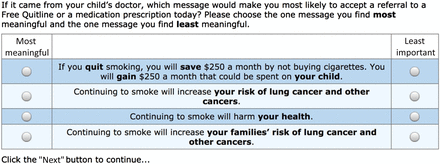
A DCE is a well-established methodology for eliciting preferences that would otherwise be difficult or impossible to get. A DCE consists of a series of tasks in which respondents are forced to choose the responses that they prefer; as a result, the DCE enables a quantification of the relative importance of each attribute. This methodology circumvents the known problems with techniques that require the individual to rank alternatives, such as Likert-style rating scales, presenting a straightforward task that more closely resembles a real-world decision.35,36 This methodology has been used in other pediatric health care studies to support development of future information-based interventions.31,32,37 The DCE was administered by using a tablet computer. Parent respondents were shown 4 messages at a time, selecting the message in each subset that was the most and least important (see Fig 1). The DCE was designed in such a way that each message is shown an equal number of times.

Sample DCE screen. Parent respondents were presented with 4 messages at a time, selecting the message in each grouping that they deemed “most” or “least” important.
Relative Importance Scores
Both the DCE (data collection) and the quantitative analysis to estimate individual preferences for each message were done by using Lighthouse Studio (version 9.7.0; Sawtooth Software, Provo, UT). The software uses a multinomial logistic regression to calculate the intensity of importance for each attribute and then transforms the scores into probability scaled scores, which allows for comparisons across attributes.38 For each person, there are 26 probability scaled scores (one for each message) that sum to 100. These ratio-scaled scores have an easy interpretation; for example, a message with a score of 6 is twice as important as a message with a score of 3.31,35
Demographic and Clinical Measures
The child’s (patient) age, sex, race, ethnicity, presence of a chronic health condition (prematurity, asthma, chronic lung disease, allergies, or attention-deficit/hyperactivity disorder), and insurance payer were obtained via parent respondent self-report. The parent’s age, sex, and education level were also obtained via parent self-report. Parents also completed measures of health literacy (via the Newest Vital Sign, a reliable and validated measure39) and nicotine dependence (measured by the Fagerström Test for Nicotine Dependence40). Quit motivation was measured before the DCE by using the Contemplation Ladder, an efficient and face-valid measure, generalizable to diverse populations and associated with objective measures of readiness to quit smoking and actual quit attempts.41–44
Statistical Analysis
Characteristics of parents and patients are presented with proportions for categorical variables and means and SDs for continuous variables. The relative importance scores for each message across all parent smokers are presented in a ranked order list, with 95% confidence intervals (CIs) for each message.
To understand the relative importance of messages within the dimensions of interest, we coded each of the 26 messages by their item properties: who was featured (child, family, or parent), framing (gain or loss), and outcome included (general health, respiratory health, cancer, risk of child becoming an adult smoker, and financial impact). We created a person-item level data set for analysis and analyzed the relationship between message dimensions and scores by using clustered data methodology, adjusting our model for the variability in outcome across respondents. Using the importance scores as the outcome, we ran multivariable mixed-effects linear regression models to measure the association of message dimensions on message importance score. The models included indicator variables for the subcategories within each dimension of interest: family and child (with parent as the reference category) in the dimension “whom the message featured,” gain framing (with loss framing as the reference category) in the dimension “how the message was framed,” and child becoming an adult smoker, general health, cancer, respiratory health (with financial impact as the reference category) in the dimension “outcome included in the message.” The regression parameter for a particular indicator variable within a dimension represents the difference in expected relative importance score for patients in that subcategory versus the reference category when the comparison is made between respondents who are in the same subcategories for the other dimensions. For example, the coefficient for gain framing represents the difference in expected scores between the 2 messages within a row in Table 1 while accounting for the correlation within the multiple scores on each respondent. We ran additional sensitivity analyses to test 2 properties of our mixed-effects modeling: (1) the normality assumption and (2) the dependence of scores when using all 26 scores per person. To test if the normality assumption could have affected our results, we fit a generalized estimating equation model, which does not assume normality, by using an identity correlation structure for the repeated measures per person and robust SEs. We also compared mixed-effects linear regression and generalized estimating equation models using all 26 scores per person (full data) as well as 25 scores per person (partial data) to ensure that the dependence across the 26 scores did not affect our results. All 4 models provided similar quantitative coefficient estimates and P values.
Statistical analyses were conducted in R version 3.6.1 (The R Foundation, Vienna, Austria)45 and Stata version 15 (Stata Corp, College Station, TX). For a sample size calculation, previous literature indicates ∼30 to 60 respondents are needed per dimensions for investigational work in a new area.31,32,46 Because we were investigating messages across 3 dimensions of interest (whom the message featured, how the message is framed, and the outcome included), we therefore chose an a priori sample size of 180 parent smokers as adequate for a reliable estimate of preferences.
Results
We enrolled 180 parent smokers after approaching 271 eligible parent smokers regarding potential participation (66.4% participation rate). Parent smokers were majority female (66.1%), displayed adequate health literacy (51.7%), and had low (40.0%) or low to moderate nicotine dependence (28.9%). Most parents fell within the 25- to 34-year (43.3%) or 35- to 44-year (33.9%) age category. Approximately half of the children were male (51.1%); many were reported by parents as African American (57.2%) and not Hispanic or Latino (85.6%) and had Medicaid insurance (69.4%). The median age of the children was 5 years (interquartile range: 1.0–9.3), and many had a history of an asthma diagnosis (30.6%) (Table 2).
Characteristics for Overall Sample
Whom the Message Featured
Overall, across the 3 dimensions of interest, parent smokers most highly prioritized cessation messages that featured the impact of smoking on their child. Child-featured messages consistently ranked highest across all messages (Fig 2). The most preferred message was “Quitting smoking will improve your child’s health by preventing respiratory illnesses like coughs, colds and wheezing” (message 2 mean rating 6.7; 95% CI, 6.5–7.0). Messages that featured the parent were of much lower importance (for highest-ranked message focused on the parent: message 8 mean rating 3.5; 95% CI, 3.2–3.9), which was half the relative importance of the highest-ranked child message. In regression models for the within-dimension message comparison, on average, messages featuring the child were most preferred, ranking 2.52 points (95% CI 2.35–2.68) higher than those featuring the parent (reference), and messages featuring the family ranked 1.74 points (95% CI 1.57–1.90) higher than those featuring the parent (reference).

Relative importance of smoking cessation messages among 180 participants. Points for different messages reflect their importance relative to each other. Numbers on the y-axis correspond to the messages listed in Table 1. 95% CIs are shown.
How the Message Was Framed
Overall, both gain- and loss-framed messages were spread throughout the distribution of message importance (Fig 2). The 3 highest-ranked messages were gain-framed messages (message 2 mean rating 6.7 [95% CI, 6.5–7.0]; message 3 mean rating 6.6 [95% CI 6.3–6.9]; message 11 mean rating 6.4 [95% CI, 6.1–6.7]) followed by 2 loss-framed messages (message 16 mean rating 6.4 [95% CI, 6.1–6.7]; message 15 mean rating 6.1 [95% CI 5.9–6.4]). For the within-dimension message comparison, on average, gain-framed messages were significantly but only slightly more preferred by parent smokers (gain framed: 0.30; 95% CI 0.17–0.43) compared to loss-framed messages (reference) (Table 3).
Comparison of Messages Within Dimensions of Interest
Outcome Included in Message
For the outcome emphasized in the message, parents ranked preventing respiratory illness (top ranked, message 2 mean rating 6.7; 95% CI, 6.5–7.0) and preventing cancer (top ranked, message 3 mean rating 6.6; 95% CI 6.3–6.9) as most important. Messages focused on the financial impact of smoking ranked lowest overall (6 of the 6 least preferred) (Fig 2). On average, messages that included respiratory health (4.35; 95% 4.16–4.54) or cancer (4.10; 95% CI 3.91–4.29) as an outcome were most preferred by parent smokers compared to messages that included financial impact of smoking (reference), followed by general health messages (3.37; 95% 3.18–3.56) or messages that included the child becoming an adult smoker (1.18; 95% 0.90–1.47) (see Table 3).
Discussion
In this study, we systematically assessed parental perceptions of smoking cessation messages to increase their intention to use evidence-based treatments to help them quit. The study was designed around intention because of widely recognized and conceptually grounded links between intention and subsequent health behaviors,47 including smoking cessation.48,49 We found that parent smokers most highly prioritized smoking cessation messages that emphasized the impact of smoking on their child’s health. Messages with outcomes that were focused on the impact of smoking on the child’s respiratory health, risk of cancer, or general health were preferred by parents as motivation to begin cessation treatment to outcomes that focus on risk of the child becoming an adult smoker or financial impact.
Known differences in adult smokers’ preference for gain- over loss-framed smoking cessation messages do not appear to be as salient in the pediatric setting. More broadly, this finding illustrates that behavioral economic approaches, widely studied and supported in the adult health care setting and based on Nobel prize–winning work in economics,12,50 may need to be adapted for the pediatric setting. Although testing of the impact of these messages on actual behavior is needed, these results are especially important nonetheless as primary care practice shifts from a focus on acute care to a growing emphasis on the prevention and care of chronic conditions,51 areas in which treatment success depends on effectively motivating the family to adopt health-promoting behaviors. Because of its many known health risks for the parent and child, parental smoking cessation is an especially salient example.
For busy pediatricians and pediatric clinicians, these findings provide ways to talk with parents that may actually make a difference in conversations that are common in clinical care. Conversations with parents about their smoking should focus on child health rather than, for example, the financial impact of smoking. Incorporating the preferred language and concerns of parents is the foundational part of motivational interviewing interventions, increasing patient engagement and intrinsic motivation as well as perceived clinician empathy.52,53 Similar to efforts to identify the preferred language that providers use to discuss obesity management with parents and adolescents,54,55 these messages can improve conversations around parent smoking, potentially increasing treatment engagement.
Messages that are focused on health outcomes, in particular respiratory illnesses or cancer, appear more important to parent smokers than messages incorporating financial impacts. This finding is in contrast to emerging evidence of adult smoker preference for financial-based messages over health-focused messages in promoting smoking cessation.56 The family context of decision-making in pediatric settings may create different emotional reactions to parent-child health messages than adult-focused messages.57 For example, researchers have identified parents’ impulse to make a treatment decision for their child that a “good parent” would make.31,58 Parents might view focusing on their child’s respiratory health, rather than overall finances, as a message that a “good parent” would choose. Regardless, this finding draws further attention to the need for a better understanding of parent decision-making to help them make healthier choices for themselves and their children.
This study has several key limitations. Parents completed the DCE via tablet computer and were assured that individual results were anonymous, but social desirability bias may have affected these results. Although smoking cessation messages were developed through proven insights from behavioral economics12–16 and parent preferences were assessed by using a rigorous methodology,35,36 behaviors were not examined to assess how parents actually respond to these messages. Stated preferences for behavior change for smoking cessation may not be related to actual behavior, such as quit attempts and eventual quitting. Although identifying parent smoker perceived importance of smoking cessation messages is important and fundamental work,7,10,11 this study does not reveal what would actually make a difference in practice. In addition, because the study population was exclusively English speaking and from one geographic area, testing of messages with non-English speakers and in other regions is warranted to confirm generalizability of findings to the broader US population. Finally, we do not know how adult e-cigarette users would respond to these messages. Future studies will evaluate if certain messages are more salient to different subgroups of parents on the basis of parent and child demographic and clinical characteristics, additional methods to deliver these smoking messages to parents in clinical practice, and the impact of these messages on subsequent smoking cessation.
Conclusions
Using rigorous methods leveraging behavioral economics and discrete choice methodologies to develop and test messages targeted at parents, we found that parent smokers most highly prioritized smoking cessation messages that emphasized the impact of smoking on their child’s health. In addition, messages that included respiratory illness, cancer, and general health were most highly prioritized. Known differences in adult smokers’ preference for gain- over loss-framed messages do not appear to be as salient in the pediatric setting. Future studies should be used to identify the best methods to deliver these messages to parent smokers, either through clinical practice or additional outreach approaches, and evaluate their impact on parent quit rates.
Acknowledgments
We thank the network of primary care clinicians and their patients and families for their contribution to this project and clinical research facilitated through the Pediatric Research Consortium at CHOP.
Footnotes
- Address correspondence to Brian P. Jenssen, MD, MSHP, Policy Lab, Children’s Hospital of Philadelphia, 2716 South St, 11-201, Philadelphia, PA 19146. E-mail: jenssenb{at}email.chop.edu
-
FINANCIAL DISCLOSURE: The authors have indicated they have no financial relationships relevant to this article to disclose
-
FUNDING: Funded by the National Cancer Institute of the National Institutes of Health under award number K08CA226390 (Dr Jenssen) and the Flight Attendant Medical Research Institute through a grant to the American Academy of Pediatrics Julius B. Richmond Center. Funded by the National Institutes of Health (NIH).
-
POTENTIAL CONFLICT OF INTEREST: Dr Schnoll has received medication and placebo free from Pfizer and has provided consultation to Pfizer. These are unrelated to the current study; the other authors have indicated they have no potential conflicts of interest to disclose.
- Copyright © 2020 by the American Academy of Pediatrics







