

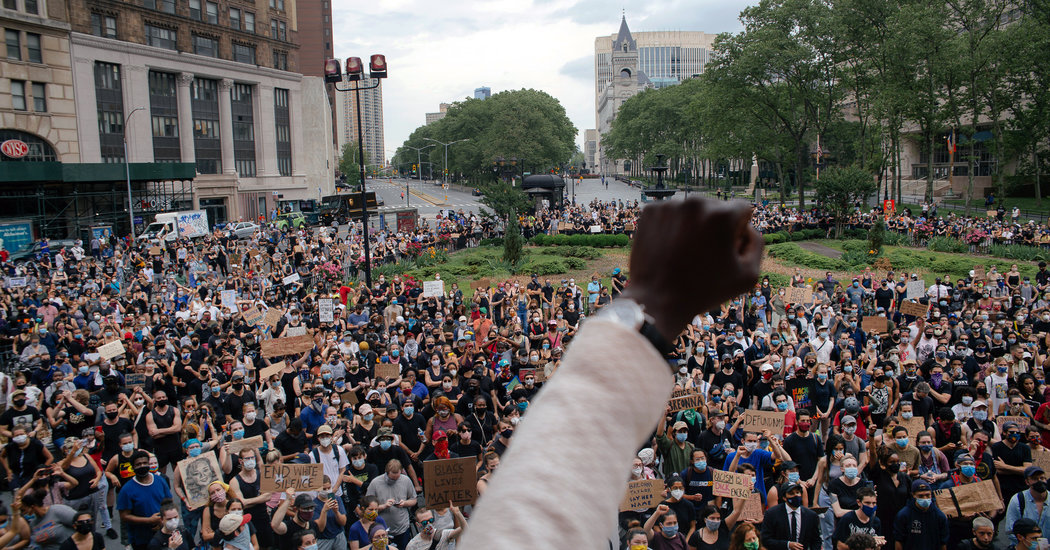
As crowds have surged through American cities to protest the killing of George Floyd, one of the striking differences from years past has been the sheer number of white people.
From Minneapolis to Washington, D.C., marchers noticed the change, and wondered what it meant that so many white Americans were showing up for the cause of justice for black Americans.
“I was shocked to see so many white kids out here,” said Walter Wiggins, 67, as he sat near the heart of the protests in Washington last week. Mr. Wiggins, a retired federal worker, who is black, remembered attending the March on Washington in 1963 and other civil rights events with his parents. “Back then, it was just black folks.”
Why is this happening now? The video of a white police officer refusing to remove his knee from Mr. Floyd’s neck for nearly nine minutes has horrified Americans as attitudes on race were already changing, particularly among white liberals. Another driver is opposition to President Trump. Protests beginning the day after his election drew large crowds. Finally, there is the coronavirus pandemic, which has left millions of Americans — including college students — cooped up at home, craving human contact. The result was hundreds of thousands of white Americans in the streets.
“This is utterly different from anything we’ve seen,” said Douglas McAdam, a sociologist at Stanford who studies social movements, referring to the recent protests. Since the death of Michael Brown in Ferguson, Mo., in 2014, every highly publicized death of an African-American man while in police custody brought protests, he said, “but overwhelmingly in the black community.”
The pattern evident in the streets has now been confirmed by early demographic data: Researchers fanned out across three American cities last weekend and found overwhelmingly young crowds with large numbers of white and highly educated people.
A team of 11 volunteers asked every fifth person they encountered to fill out a survey and gathered data from 195 people in New York, Washington and Los Angeles. The researchers, Dana R. Fisher, a sociologist at the University of Maryland, and Michael T. Heaney, a political scientist at University of Michigan, used an established method for studying street protests. They said their numbers provided only rough estimates, but offer the first, more systematic look at who the protesters are.
White protesters made up 61 percent of those surveyed in New York over the weekend, according to the researchers, and 65 percent of protesters in Washington. On Sunday in Los Angeles, 53 percent of protesters were white.
It is not just protests. White Americans are going through a wave of self-examination, buying books about racism, talking to black friends, and arguing within their own families. Still, how much of this translates into broader change remains to be seen.
“All of these white people on the front lines of these protests go back to their white neighborhoods and their overwhelmingly white and better schools,” said Hakeem Jefferson, who is black and a political scientist at Stanford University. “They protest alongside them, but they don’t live alongside them,” he said, referring to black people.
He added: “As much as people really want that progress narrative, I don’t think it exists yet.”
While opinion polls on race do not always capture what people actually think, surveys have shown that racial attitudes among white Americans have been shifting. There has been a sudden and sharp turn by white liberals toward a much more sympathetic view of black people in recent years, said Andrew Engelhardt, a postdoctoral researcher at Brown University, who has published papers documenting the shift.
“In the last 10 years or so we’ve seen something unprecedented with white Democrats,” Dr. Engelhardt said.
Racial groups tend to feel warmest toward their own group. White people favor white people, and black people favor black people. But by 2018, white liberals felt more positively about blacks, Latinos and Asians than they did about whites. That reversal surfaced in a recent poll by the Pew Research Center: About 49 percent of white Democrats said it bothered them that their nominee would be a white man, while just 28 percent of black Democrats said so.
The researchers who collected data last weekend found that the crowds were overwhelmingly young and well educated. More than three quarters of those surveyed were under the age of 34, and 82 percent of white protesters had a college degree, while 67 percent of black protesters had one.
Younger Americans are much more racially diverse than earlier generations and tend to have different views on race.
“My parents have a lot of learning to do,” said Isabel Muir, 22, a recent college graduate, who was standing in front of St. John’s Church on Saturday in Washington. She said she was having conversations on social media, and with her mother, about “how to be a white ally.”
When her mother, who is 62, questioned the property destruction during some protests, Ms. Muir said she told her that “we have to understand this community’s pain. This economy has been built on their backs.”
Mr. Trump also appeared to be a powerful driver. Forty-five percent of white people surveyed in Dr. Fisher’s work selected Mr. Trump as a motivation for joining the protests, compared with 32 percent of black people. White people were most likely to report having attended the 2017 Women’s March, but the second-least likely, after Asians, to report having attended the March for Racial Justice in 2017.
“My outrage for Trump is so strong,” said Tanya Holtzapple, 56, who is white, walking in a crowd of people on I Street on Saturday in Washington. Since he was elected, she said, she has felt “energized,” and marching was channeling that energy. “I’m not just sitting at home,” she said.
Since 2017, as many as 27 million people have taken part in protests opposing Mr. Trump, equal to about 8 percent of the population, according to researchers from Harvard University and the University of Connecticut.
These protests are part of that surge, said Dr. Fisher, who compiled the data on the protests last weekend. Groups like Indivisible, March On and Swing Left, whose goal is to prevent Mr. Trump’s re-election, may see joining the protests against police brutality both as a moral necessity and a way to “expand their tent,” she said.
“It’s emblematic of this moment, which is about the big-L left starting to pay attention to this issue,” Dr. Fisher said. “Groups not typically focused on racial justice and police brutality are turning people out.”
White Americans have taken part in struggles for racial equality at times — as abolitionists in the 19th century and Freedom Riders in the 1960s. But scholars of race in America said it remained to be seen whether a heightened awareness of racial injustice now would lead to broad change. Condemning the killing of Mr. Floyd, said Jennifer Chudy, a political scientist at Wellesley College, was “relatively costless.”
“Who is going out on a limb when they are distancing themselves from murder?” Dr. Chudy asked. Her work has shown that most white Americans have sympathy for a stark story of a sufferer and a villain — much like in the video of Mr. Floyd’s death — but far lower rates of sympathy for more abstract mistreatment, like a polluting bus depot in a mostly-black neighborhood. Some participants will become passionate for life, she said, but most w will not. For some of them, “it may be nothing more than a fad.”
In a recent Monmouth University poll, 71 percent of white respondents called racism and discrimination “a big problem” in the United States, a spike since 2015. But Dr. Jefferson, the political scientist at Stanford, argued that it was too early to declare that a national reckoning had arrived. He pointed to another finding in the same poll: Just 49 percent of white Americans say that the police are more likely to use excessive force against a black culprit.
Karyn Wills, 57, who came to the protest in Washington on Saturday, said she was hopeful. Dr. Wills, who is African-American and a medical doctor, remembers protesting as a child with her parents in Chicago. She raised her children in suburban Maryland, and said she believed their generation, which was so much more racially mixed than hers, would bring progress. “Some people out here are just curious — they’ll have a sign, post on social media, and life will go on,” she said. “But for some of them it really will spark change.”







