

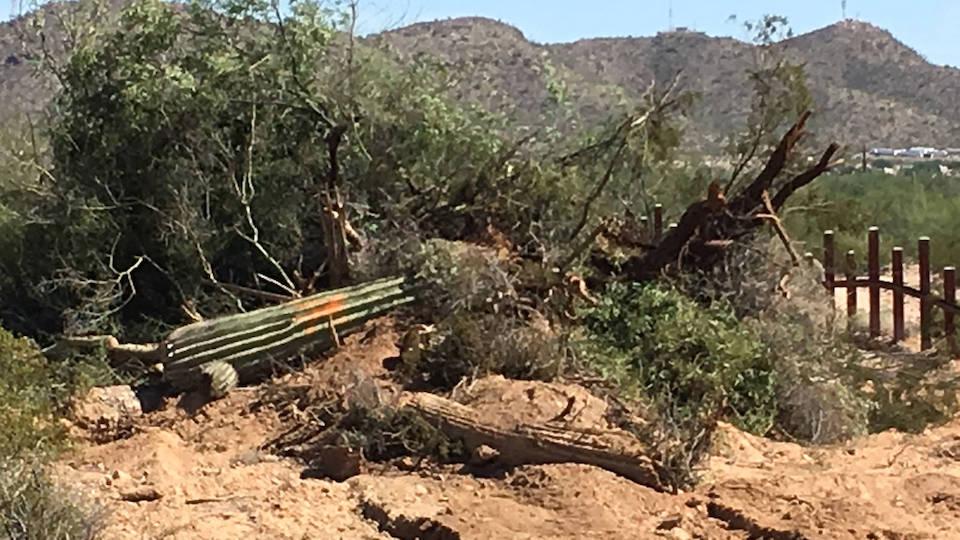
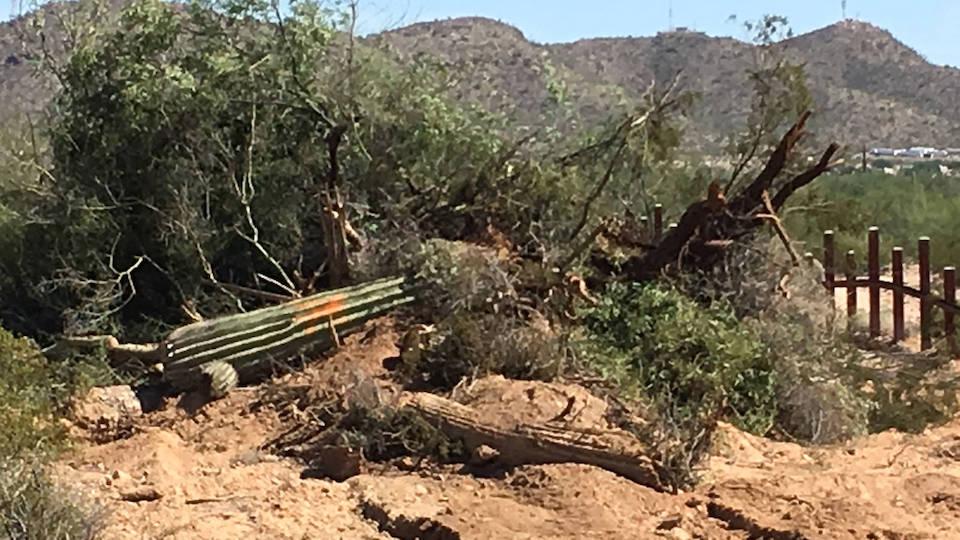
Groups are alleging that saguaro cactus knocked down for a border wall in Organ Pipe Cactus National Monument are being sold illegally/NPCA, Kevin Dahl file
Arizona’s attorney general has been asked to investigate the possible theft and illegal sale of saguaro cactus that were removed from or knocked down in Organ Pipe Cactus National Monument to make way for a 30-foot-tall border wall.
“We wish to express our concern regarding attempted sales of saguaros in Ajo, Arizona, apparently done without tags or permits authorized by the Arizona Department of Agriculture,” reads part of the letter sent Monday to Attorney General Mark Brnovich. “If verified, these alleged efforts to sell saguaros from border wall construction sites offer a tangible example of the failure of the Pentagon, Customs and Border Protection Agency, and Army Corps of Engineers to keep their contractors within the law.”
Construction on the wall, intended to stem cross-border illegal activities, got under way in Organ Pipe last summer. The construction tore up the park’s landscape along the US-Mexico border as the Trump administration has insisted a wall be erected to stem the flow of Central American immigrants to the United States. The work occupied a 60-foot wide swath of what’s known as the “Roosevelt Reservation” in the monument. All told, the work could affect 218 acres within Organ Pipe, according to a National Park Service report.
While the wall has proven not to be impervious, its construction has been destructive to the national monument and could impede wildlife migrations, notably of rare Sonoran pronghorns. Too, a quick field survey by National Park Service archaeologists in June 2019 along 11 miles of the borderlands where the wall was to be built identified five archaeological sites. That survey left the archaeologists of the mind that “significant, presently-unrecorded surface-level and buried archaeological deposits persist across the project (are), and we must assume that all such unrecorded deposits will be destroyed over the course of ensuing border wall construction.”
Construction crews have resorted to bulldozers and even explosives to level a path for the wall. According to the groups that wrote Brnovich, while some 2,000 cacti were transplanted to other areas in the eary days of the wall’s construction, later Southwest Valley Constructors bulldozed “hundreds if not thousands of cacti it claimed could not be transplanted.”
At the same time, “a significant numbers of saguaros were still removed, mutilated and placed in truck trailers and transported away on State Highway 85 toward Ajo. What is of legal concern is whether subcontractors had any state tags and permits to transport these uprooted or damaged saguaros on public highways as required by law, and whether they had authorization to sell or donate these saguaros as they attempted on October 17th in front of three witnesses.”
The Arizona State Native Plant Law was first passed in 1929, and its current Arizona Revised Statute §3-906 spells out rules regarding the collection and salvage of protected plants; procedures, permits, tags and seals; duration; and means to request exceptions that have been in place since 2005.
Groups signing onto the letter included the Border Coalition, National Parks Conservation Association, Natural History Institute, Arizona-Sonora Desert Museum, Center for Biological Diversity, Desert Botanical Garden,Society for Conservation Biology, Boyce-Thompson Arboretum, Friends of Tucson’s Birthplace, Wilderness Watch, and Borderlands Restoration.
The groups alleged that employees of Southwest Cactus, LLC, a business that transplants saguaros, last October approached Ajo businesses with offers of selling them “as many cacti as they want.” A call to Southwest Cactus on Tuesday was not immediately returned.
National Park Service officials in the agency’s Intermountain Region office in Denver did not immediately respond to an email asking if they were aware of the allegations.







