
GLOBAL RESEARCH SYNDICATE
No Result
View All Result
  • Login
  • Latest News
  • Consumer Research
  • Survey Research
  • Marketing Research
  • Industry Research
  • Data Collection
  • More
    • Data Analysis
    • Market Insights
  • Latest News
  • Consumer Research
  • Survey Research
  • Marketing Research
  • Industry Research
  • Data Collection
  • More
    • Data Analysis
    • Market Insights
No Result
View All Result
globalresearchsyndicate
No Result
View All Result
Home Data Collection

Intel Photonics Engine Promises Energy-Efficient Data Capacity | Research & Technology | Apr 2020

globalresearchsyndicate by globalresearchsyndicate
April 3, 2020
in Data Collection
0
Intel Photonics Engine Promises Energy-Efficient Data Capacity | Research & Technology | Apr 2020
0
SHARES
1
VIEWS
Share on FacebookShare on Twitter

SAN FRANCISCO, April 2, 2020 — A research team at Intel has developed a photonic engine with the equivalent processing power of 16 100-Gb transceivers, or four of the latest 12.8-Tb generation.

At the Optical Networking and Communication Conference in San Diego, Intel researchers described a possible solution to helping computer networks keep up with a growing demand for data.


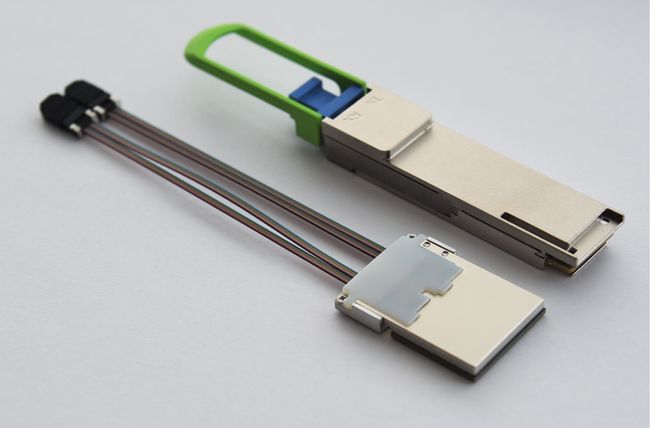
A 1.6-Tb engine (left) next to an industry standard 100-Gb pluggable transceiver (right). Courtesy of Robert Blum.


Reports from 2019 suggest that approximately 2.5 quintillion bytes of data are produced each day, and that number is growing. All that data has to be routed from consumer hard drives and other processors through multiple servers as it passes through other computers.

According to Robert Blum, director of marketing and business at Intel, the challenge is figuring out how to get data to go in and out of the chip without losing information or slowing down processing. Loss in optical systems still occurs at the inevitable boundaries between materials in a hybrid optoelectronic system.

“To get data to and from the switch ASIC would require 128 pluggable transceiver modules operating at 100 Gb/s or 32 400-Gb transceivers,” Blum said. But, he said, because the distance between the switch and the pluggable modules can be around 12 inches, these electrical links are lossy and power hungry.

“With the 1.6-Tb/s photonic engine, you can co-package the photonics in the same multichip package as the switch ASIC,” Blum said. “To support 12.8 Tb, you would co-package eight of these engines into the same package as the switch ASIC.”

Due to COVID-19, Intel’s live demonstration was held at its San Francisco headquarters instead of San Diego as originally planned, while the team’s paper was presented over video.

Blum said the close integration of the optical components allows Intel’s chip to “break the wall” of the maximum density of pluggable port transceivers on a switch ASIC. More ports on a switch means higher processing power, but a limited number of connectors can fit together before the system overheats.

“With this innovation, higher levels of bit rates are possible because you are no longer limited by electrical data transfer,” Blum said. “Once you get to optical computing, distance is free — 2 meters, 200 meters, it doesn’t matter.”

There’s also the factor of expense. Sending high-speed data over the foot-long copper trays creates a cost barrier while consuming a high amount of energy.

“As speed goes higher, you need more power,” said lead device integration engineer Saeed Fathololoumi. “With optical, it is literally lossless at any speed.”

The co-packaged photonic engine currently exists as a functional demo at Intel’s lab. The demonstration at the conference used a P4-programmable Barefoot Tofino 2 switch ASIC capable of speeds reaching 12.8 Tb/s, in combination with Intel’s 1.6-Tb/s silicon photonics engines.

“The optical interface is already the standard industry interface, but in the lab we’re using a switch that can talk to any other switch using optical protocols,” Blum said.

It’s the first step toward an all-optical input-output scheme, which Intel believes may offer future data centers a way to cope with the rapidly expanding data demands of the internet-connected public. For the Intel team, that means working with the rest of the computing industry to define the initial deployments of the new engines.

“We’ve proven out the main technical building blocks, the technical hurdles,” Fathololoumi said. “The risk is low now to develop this into a product.”


 

Related Posts

How Machine Learning has impacted Consumer Behaviour and Analysis
Consumer Research

How Machine Learning has impacted Consumer Behaviour and Analysis

January 4, 2024
Market Research The Ultimate Weapon for Business Success
Consumer Research

Market Research: The Ultimate Weapon for Business Success

June 22, 2023
Unveiling the Hidden Power of Market Research A Game Changer
Consumer Research

Unveiling the Hidden Power of Market Research: A Game Changer

June 2, 2023
7 Secrets of Market Research Gurus That Will Blow Your Mind
Consumer Research

7 Secrets of Market Research Gurus That Will Blow Your Mind

May 8, 2023
The Shocking Truth About Market Research Revealed!
Consumer Research

The Shocking Truth About Market Research: Revealed!

April 25, 2023
market research, primary research, secondary research, market research trends, market research news,
Consumer Research

Quantitative vs. Qualitative Research. How to choose the Right Research Method for Your Business Needs

March 14, 2023
Next Post
Global Synthetic Porcine Secretin Market Research 2020 Report

Global Synthetic Porcine Secretin Market Research 2020 Report

Categories

  • Consumer Research
  • Data Analysis
  • Data Collection
  • Industry Research
  • Latest News
  • Market Insights
  • Marketing Research
  • Survey Research
  • Uncategorized

Recent Posts

  • Ipsos Revolutionizes the Global Market Research Landscape
  • How Machine Learning has impacted Consumer Behaviour and Analysis
  • Market Research: The Ultimate Weapon for Business Success
  • Privacy Policy
  • Terms of Use
  • Antispam
  • DMCA

Copyright © 2024 Globalresearchsyndicate.com

Welcome Back!

Login to your account below

Forgotten Password?

Retrieve your password

Please enter your username or email address to reset your password.

Log In
This website uses cookies to improve your experience. We'll assume you're ok with this, but you can opt-out if you wish. Cookie settingsACCEPT
Privacy & Cookies Policy

Privacy Overview

This website uses cookies to improve your experience while you navigate through the website. Out of these cookies, the cookies that are categorized as necessary are stored on your browser as they are essential for the working of basic functionalities of the website. We also use third-party cookies that help us analyze and understand how you use this website. These cookies will be stored in your browser only with your consent. You also have the option to opt-out of these cookies. But opting out of some of these cookies may have an effect on your browsing experience.
Necessary
Always Enabled
Necessary cookies are absolutely essential for the website to function properly. This category only includes cookies that ensures basic functionalities and security features of the website. These cookies do not store any personal information.
Non-necessary
Any cookies that may not be particularly necessary for the website to function and is used specifically to collect user personal data via analytics, ads, other embedded contents are termed as non-necessary cookies. It is mandatory to procure user consent prior to running these cookies on your website.
SAVE & ACCEPT
No Result
View All Result
  • Latest News
  • Consumer Research
  • Survey Research
  • Marketing Research
  • Industry Research
  • Data Collection
  • More
    • Data Analysis
    • Market Insights

Copyright © 2024 Globalresearchsyndicate.com



