

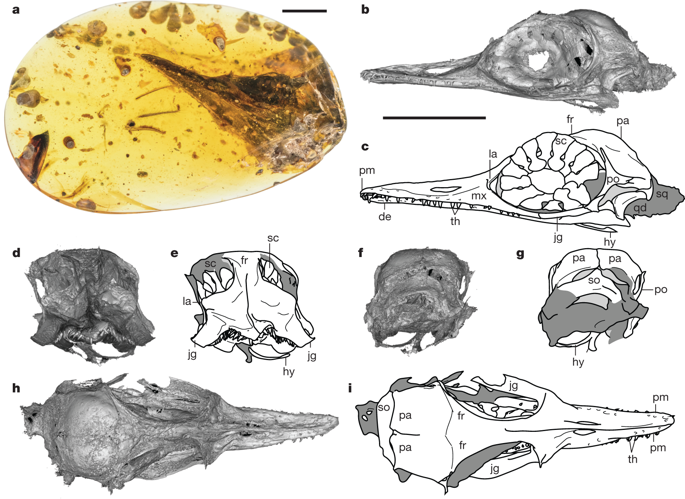
Xing, L. et al. Mummified precocial bird wings in mid-Cretaceous Burmese amber. Nat. Commun. 7, 12089 (2016).
Xing, L. et al. A feathered dinosaur tail with primitive plumage trapped in mid-Cretaceous amber. Curr. Biol. 26, 3352–3360 (2016).
Daza, J. D. et al. An enigmatic miniaturized and attenuate whole lizard from the Mid-Cretaceous amber of Myanmar. Breviora 563, 1–18 (2018).
Xing, L.-D. et al. A mid-Cretaceous enantiornithine (Aves) hatchling preserved in Burmese amber with unusual plumage. Gondwana Res. 49, 264–277 (2017).
Xing, L.-D. et al. A flattened enantiornithine in mid-Cretaceous Burmese amber: morphology and preservation. Sci. Bull. (Beijing) 63, 235–243 (2018).
Xing, L. et al. A fully feathered enantiornithine foot and wing fragment preserved in mid-Cretaceous Burmese amber. Sci. Rep. 9, 927 (2019).
Xing, L., McKellar, R. C., O’Connor, J. K., Niu, K. & Mai, H. A mid-Cretaceous enantiornithine foot and tail feather preserved in Burmese amber. Sci. Rep. 9, 15513 (2019).
Xing, L. et al. A new enantiornithine bird with unusual pedal proportions found in amber. Curr. Biol. 29, 2396–2401.e2 (2019).
Hanken, J. & Wake, D. B. Miniaturization of body size: organismal consequences and evolutionary significance. Annu. Rev. Ecol. Syst. 24, 501–519 (1993).
Westerweel, J. et al. Burma Terrane part of the Trans-Tethyan Arc during collision with India according to palaeomagnetic data. Nat. Geosci. 12, 863–868 (2019).
Shi, G. et al. Age constraint on Burmese amber based on U-Pb dating of zircons. Cretac. Res. 37, 155–163 (2012).
Field, D. J. et al. Complete Ichthyornis skull illuminates mosaic assembly of the avian head. Nature 557, 96–100 (2018).
Smith, R. D. A. & Ross, A. Amberground pholadid bivalve borings and inclusions in Burmese amber: implications for proximity of resin-producing forests to brackish waters, and the age of the amber. Earth Environ. Sci. Trans. R. Soc. Edinb. 107, 239–247 (2018).
Lovette, I. J. & Fitzpatrick, J. W. The Handbook if Bird Biology 3rd edn (Princeton Univ. Press, 2004).
Dalsgaard, B. et al. Trait evolution, resource specialization and vulnerability to plant extinctions among Antillean hummingbirds. Proc. R. Soc. Lond. B 285, 20172754 (2018).
Glaw, F., Köhler, J., Townsend, T. M. & Vences, M. Rivaling the world’s smallest reptiles: discovery of miniaturized and microendemic new species of leaf chameleons (Brookesia) from northern Madagascar. PLoS ONE 7, e31314 (2012).
Yeh, J. The effect of miniaturized body size on skeletal morphology in frogs. Evolution 56, 628–641 (2002).
Griffith, H. Miniaturization and elongation in Eumeces (Sauria: Scincidae). Copeia 1990, 751–758 (1990).
Chiappe, L. M., Ji, S., Ji, Q. & Norell, M. A. Anatomy and systematics of the Confuciusornithidae (Theropoda: Aves) from the Late Mesozoic of northeastern China. Bull. Am. Mus. Nat. Hist. 242, 1–89 (1999).
Elzanowski, A. Embryonic bird skeletons from the Late Cretaceous of Mongolia. Palaeontologica Polonica 42, 147–179 (1981).
Jollie, M. T. The head skeleton of the chicken and remarks on the anatomy of this region in other birds. J. Morphol. 100, 389–436 (1957).
Edinger, T. Über Knöcherne Scleralringe (Fisher, 1929).
Schmitz, L. Quantitative estimates of visual performance features in fossil birds. J. Morphol. 270, 759–773 (2009).
Schmitz, L. & Motani, R. Morphological differences between the eyeballs of nocturnal and diurnal amniotes revisited from optical perspectives of visual environments. Vision Res. 50, 936–946 (2010).
Schmitz, L. & Motani, R. Nocturnality in dinosaurs inferred from scleral ring and orbit morphology. Science 332, 705–708 (2011).
Rauhut, O. W. M. The Interrelationships and Evolution of Basal Theropod Dnosaurs (Special Papers in Palaeontology 69) (The Palaeontological Association, London, 2003).
O’Connor, J. & Chiappe, L. M. A revision of enantiornithine (Aves: Ornithothoraces) skull morphology. J. Syst. Palaeontology 9, 135–157 (2011).
Xu, X. & Norell, M. A. A new troodontid dinosaur from China with avian-like sleeping posture. Nature 431, 838–841 (2004).
O’Connor, J. K. The trophic habits of early birds. Palaeogeogr. Palaeoclimatol. Palaeoecol. 513, 178–195 (2019).
Rittmeyer, E. N., Allison, A., Gründler, M. C., Thompson, D. K. & Austin, C. C. Ecological guild evolution and the discovery of the world’s smallest vertebrate. PLoS ONE 7, e29797 (2012).
Hu, H. et al. Evolution of the vomer and its implications for cranial kinesis in Paraves. Proc. Natl Acad. Sci. USA 116, 19571–19578 (2019).
Bout, R. G. & Zweers, G. A. The role of cranial kinesis in birds. Comp. Biochem. Physiol. A Mol. Integr. Physiol. 131, 197–205 (2001).
Rayfield, E. J. Aspects of comparative cranial mechanics in the theropod dinosaurs Coelophysis, Allosaurus and Tyrannosaurus. Zool. J. Linn. Soc. 144, 309–316 (2005).
Degrange, F. J., Tambussi, C. P., Taglioretti, M. L., Dondas, A. & Scaglia, F. A new Mesembriornithinae (Aves, Phorusrhacidae) provides new insights into the phylogeny and sensory capabilities of terror birds. J. Vertebr. Paleontol. 35, e912656 (2015).
Holliday, C. M. & Witmer, L. M. Archosaur adductor chamber evolution: integration of musculoskeletal and topological criteria in jaw muscle homology. J. Morphol. 268, 457–484 (2007).
Witmer, L. M. The evolution of the antorbital cavity of archosaurs: a study in soft-tissue reconstruction in the fossil record with an analysis of the function of pneumaticity. J. Vertebr. Paleontol. 17, 1–73 (1997).
O’Connor, J. K., Chiappe, L. M. & Bell, A. in Living Dinosaurs: the Evolutionary History of Birds (eds Dyke, G. D. & Kaiser, G.) 39–114 (John Wiley & Sons, 2011).
Bailleul, A. M., Li, Z., O’Connor, J. & Zhou, Z. Origin of the avian predentary and evidence of a unique form of cranial kinesis in Cretaceous ornithuromorphs. Proc. Natl Acad. Sci. USA 116, 24696–24706 (2019).
Zhou, Z. & Zhang, F. A long-tailed, seed-eating bird from the Early Cretaceous of China. Nature 418, 405–409 (2002).
Xu, X. Mosaic evolution in birds: brain vs. feeding apparatus. Sci. Bull. (Beijing) 63, 812–813 (2018).
Goloboff, P. A., Carpenter, J. M., Arias, J. S. & Esquivel, D. R. M. Weighting against homoplasy improves phylogenetic analysis of morphological data sets. Cladistics 24, 758–773 (2008).
Xing, L.-D., McKellar, R. C. & O’Connor, J. An unusually large bird wing in mid-Cretaceous Burmese amber. Cretaceous Res. 110, 104412 (2020).
Chen, R.-C. et al. PITRE: software for phase-sensitive X-ray image processing and tomography reconstruction J. Synchrotron Radiat. 19, 836–845 (2012).
Symonds, M. R. E. & Blomberg, S. P. in Modern Phylogenetic Comparative Methods and their Application in Evolutionary Biology (ed. Garamszegi, L. Z.) 105–130 (Springer, 2014).
Jetz, W., Thomas, G. H., Joy, J. B., Hartmann, K. & Mooers, A. O. The global diversity of birds in space and time. Nature 491, 309–316 (2012).
Jetz, W. et al. Distribution and conservation of global evolutionary distinctness in birds. Curr. Biol. 24, 919–930 (2014).







