

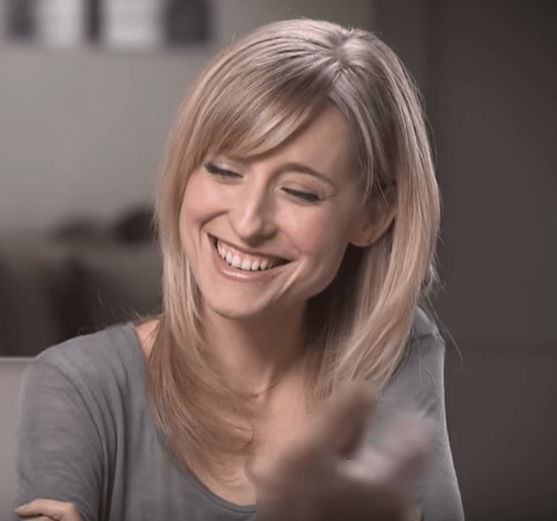
This is part 3 on our series on sex-slaver Keith Alan Raniere teaching his sex-slave, former actress Allison Mack.
Part #1 Allison Mack Questions Her Sex Slaver Leader Keith Raniere on ‘What Is Creativity?’
Allison Mack Breaks Down and Cries When Sex-Slaver Raniere Speaks to Her About ‘Authenticity’
The work of transcribing was accomplished by Marie White working off a video of Keith Raniere’s conversation with Allison Mack.
https://www.youtube.com/watch?v=0PTG0CB_biM&authuser=1
In this fascinating part of the conversation, we hear the Profound One, Keith Raniere, speak of acting. He is a man who has never acted except in amateur theater [he was in amateur productions of Sweeney Todd] and purports to teach actress Allison Mack, who literally made millions of dollars from acting on TV.
This shows the level of faith that Allison and others had in his raw, pure genius. He knew more about acting than any professional actor ever could.
Indeed he knew more about everything because he was the smartest man in the world, Allison thought.
In this delightful section, we get more of his wondrous word salad, topped with a heaping helping of bullshit dressing.
Rarely has anyone said so little in so many words.
Keep in mind that the woman he is speaking to was not only a seasoned actress, who quit acting to follow him, but also a felon having followed him in his racketeering enterprise and, but for her plea bargain, she would have been convicted of sex trafficking by coercing women into having sex with him.

The Conversation
Keith: Of course, there’s things, there’s people, who are naturally inauthentic but that’s a different sort of a thing. So here we, we see art and we have the expression which is when a human either expresses through gesture or some sort of communication where literally [there is] some sort of material transformation. What we call art and the impression is what we get from our senses and how we interpret it and interpret the world around.
You know, I have a certain impression of this table, besides the impression of its color and its age and a bunch of other intellectualizations.
I also have very metaphysical impressions, things that I, I am not sure of, for example, exactly how hard would I have to throw a ball to hit the edge of the table? How much energy would I actually spend to reach my arm across? That’s an unknown, but by using my senses and feeling this table I could even. maybe, guess what its weight would be, like, might be very surprised, but we do a lot of guesstimation on the world through our impressions of the world.
And that’s very important because when I have an impression of something that’s, that’s art, it allows me to project a type of creativity, a type of authenticity of the person that created that art, or some aspect of human creativity through the art. So if I look at a sculpture or a picture, there is okay, “Wow, that’s a nice sculpture. Wow, it’s really done well” etc., but it has more than that.
It has the distinct feelings that humans hands did this, and if I look at a sculpture very, very protracted, um, unless it is absolutely mechanical, I start to feel like I can imagine myself almost sculpturing it.

[Keith continues] I sort of imagine the hands doing it. I imagine maybe what that felt like to make that and as I start to get these impressions from the art, I start to believe I understand the artist’s expression of something that transcends our science. Sometimes it’s totally off. Sometimes what we get as an impression is very different than the what the artist intended as an expression, or maybe even what other people get as an impression of the same thing, but the impression at expression aspect of existence is the type of communication that goes beyond science.

Our communication that is data-information-based is very measurable and scientific, but when we start to use expression and impression we summon to our aid all of the different things that we can use to try to get across a message very deeply to you.
So if I want to express anger, one way of saying is “I am angry”. Another way is to rile my body into an angered state and do 100,000 little things that indicate anger and a lot of them you get. I don’t realize, I’m doing them. You don’t realize you’re getting them, but the impression wells within you, “Wow, he’s angry!”
Sometimes we can’t even put our finger on it and it is the most complex constellation. Now of course you can do that and not do as much of a constellation.

Allison: Umhum

Keith: You know how, how much your, there’s an initial constellation of anger, and that humans in general have a type of constellation we generally identify as anger and then how they rally their body around, that has to do with the expression of the self. So it’s as if these very fundamental human things that we do are the foundation of not only the expression of anger, but that individuals anger, and actually hint at the nature of the individual’s soul. Soes that make sense?

Allison: Umhum

Keith: So authenticity is congruence of expression.

Allison: Ah, I want to talk a little bit about, The Source, which is a company that you created for actors/artist people who want to get better at expressing in general. Um, several years ago when we first met, I had said to you “would you be able to be willing to work with me becoming a better actress?” and you said, “yeah,” you know, “we’ll talk about it.
And then, several years later, you started working with me and a bunch of other people to develop a curriculum specifically for actors and I’ve been talking to different people about it and like different actors and things like that, enrolling them in the idea and coming and participating and see what you’ve created because it’s been incredible for me and a lot of the questions they ask is how is it different from … [Stella] Adler [acting school] or whatever and a lot of what the answers I have given have been like, well it’s sort of a partnership with that because it gives you the foundation underneath all of the technical skills and all of the kind of traditional approaches to acting we’ve had throughout time.
Like it really gets to the core of the actor, so you can work on the raw material, and then everything else that they produce is affected by that. But I don’t know. I’m curious to know, what your perception is of the curriculum that you created and where it came from.

Keith: Well it comes from a mix of human behavior and philosophy and also really technical communication. You know, acting is all about a type of communication and being not only more aware but more congruent in your communication so you want people to, if you will, and I’m going to be a bit, mmm, common in what I say, you want people “to buy your character.”

Allison: Right

Keith: And the way they buy it, is they find it congruent and authentic. The question, I mean if somebody could be totally congruent, and a character and express authentically through that character so they can do any sort of a scene or whatever, certainly that actor can do anything.
So the question is how do you achieve that? How do you achieve congruence? How do you achieve authenticity? And I think that there are many roads to do this.
The thing that I think makes The Source a bit unique is I come from a non-acting background. You could say, I don’t know what I’m talking about.

Allison: Which is, yeah–

Keith: So that’s good and bad. The good aspect is that it comes from a, a behaviorist humanist sort of practical and philosophical background, dealing with communication, dealing with all sorts of things relating to the psychodynamics of people and humans without being tainted by the current pedagogy of acting and there’s both good and bad.
You have something that comes in like that fresh. It provides a tool that goes outside of the box of all the normal tool sets. You know any actor that wants to create a methodology of acting, especially if they know there is other methodologies, they’re influenced then a certain way and that can be very, very good, but at times it’s also good to have something that is not influenced in the normal way by that.

Allison: Umhum
Keith: As if coming from another planet
Allison: Umhum
Keith: So to some degree, The Source, it’s not just created for actors. It’s created for human communication. It’s something that can be used in arbitration. It’s something that can be used in negotiation. It’s something that can be used in parenting. It’s something that can be used in a love relationship.
Allison: Umhum
Keith: And it comes from that perspective but it does have a strong application to what you would call authentic congruent expression and it’s not tainted by the other schools that are all extraordinary. It’s not at all that they’re not great. It’s that this is different. So one of the things you can say about The Source, truly, because the way it was created had not much to do with acting. It had to do with human psychodynamic. It has to do with the whole psychodynamic model of not only human behavior but human moral ethical action.
So understanding that; understanding the way that functions with the body, within the emotions, within the thoughts and how thoughts interrelate with all those things. Emotions interrelate and how they all are together as a system. It is a body of knowledge that was grown specifically apart from the major schools, not only affecting but, um, of psychology and philosophy and it’s unique and in its uniqueness is its power and that’s one of the, I think, an important thing about it.

Allison: Yeah, you said once it gets you to the source of your genius and the source of your insecurities
Keith: Umhum
Allison: It sort of allows you to kind of get in there with the root of both of those things.
End of Conversation

Word Salad on a Platter
Well there you have it. You just learned it all, from a guy who knows everything.
Let’s enjoy some word salad and bogus-deep:
Keith said:
We do a lot of guesstimation on the world through our impressions of the world.
***
The impression at expression aspect of existence is the type of communication that goes beyond science.
***
Our communication that is data-information-based is very measurable and scientific, but when we start to use expression and impression we summon to our aid all of the different things that we can use to try to get across a message very deeply.
***
Sometimes we can’t even put our finger on it and it is the most complex constellation. Now of course you can do that and not do as much of a constellation.
***
Authenticity is congruence of expression.
***
The good aspect is that it comes from a behaviorist humanist sort of practical and philosophical background.
***
Dealing with communication, dealing with all sorts of things relating to the psychodynamics of people and humans.
***
It has to do with the whole psychodynamic model of not only human behavior but human moral ethical action.
****
A few comments
This is important perhaps because we are studying the mind, and human attraction. How a star like Allison Mack could have been taken in by this blather and ruin her life by following him.
Normally bullshit is not worth studying and in Raniere’s case his work of deceiving people is over. He is in prison and that is where he will remain for years to come.
But let us look at how flimsy his argument is. And ponder how someone could be deceived with such nonsense.
My comments in [bold and brackets].
Allison: I want to talk a little bit about, The Source” …
Keith: It comes from a mix of human behavior and philosophy and also really technical communication.”
[The Source was in fact the usual hodgepodge of Raniere plagiarism and bullshit. As I said before, paraphrasing Johnson, “It was both good and original. Only what is good is not original, and what is original is not good.]
…. The thing that I think makes The Source a bit unique is I come from a non-acting background. [Yes, that does make it unique, a non-actor charging people $10,000 for a course on acting.] You could say, I don’t know what I’m talking about. [That may be true.]
… The good aspect is that it comes from a behaviorist humanist sort of practical and philosophical background [What?] dealing with communication, dealing with all sorts of things relating to the psychodynamics of people and humans [both people and humans?] without being tainted by the current pedagogy of acting [He has a better, more advanced method].
Allison: Umhum
Keith: You have something that comes in like that fresh [Imagine if this was applied to any art or science — someone who never did the practice is ‘fresh.” Why? Because Raniere is a genius. Think of his fresh foray into real estate investment in Los Angeles, or his commodities investing, or his multilevel marketing – Consumers’ Buyline – or even his fresh approach to staying out of prison by not putting on a defense at trial.]
It provides a tool [His not being an actor] that goes outside of the box of all the normal tool sets. [This is really his main argument –that his genius is so great that he does not need to be an actor to teach acting better than anyone. There is no other argument, since it is utterly preposterous to argue that someone who does not know how to paint, for instance, would teach art classes, or someone who never flew a plane should teach people how to fly.]
Allison: Umhum
Keith: You know any actor that wants to create a methodology of acting… they’re influenced … a certain way and that can be very, very good, but at times it’s also good to have something [i,e Raniere’s teachings on acting] that is not influenced in the normal way by that. As if coming from another planet.
Allison: Umhum
Keith: To to some degree, The Source, it’s not just created for actors. It’s created for human communication [which he does somewhat poorly with non Nxivm members]. It’s something that can be used in arbitration. [He never settled a legal case; he always sued until he lost or bankrupted his opponent]. It’s something that can be used in negotiation [He lost money on all or most of his business deals]. It’s something that can be used in parenting [He denied he was the father of his first born son and broke up families]. It’s something that can be used in a love relationship. {he used all women as objects.]
Allison: Umhum
Keith: And it comes from that perspective, but it does have a strong application to what you would call authentic congruent expression [what?] and it’s not tainted by the other schools…. It’s not at all that they’re not great. It’s that this is different. [Yes, this is the course created by someone who never acted professionally.] So one of the things you can say about The Source, truly, because the way it was created had not much to do with acting. It had to do with human psychodynamic. [What?] It has to do with the whole psychodynamic model of not only human behavior but human moral ethical action. [What is he actually talking about?]
Allison: Umhum
Keith: … It is a body of knowledge that was grown specifically apart from the major schools, [obviously] not only affecting … psychology and philosophy and it’s unique and in its uniqueness is its power [uniqueness is, in this case, the fact that the originator of the material never made his living from the material he is charging to teach].
Allison: Umhum
***’
It could have been said much simpler. “Because I never made living as an actor, I have a different view of acting and that makes it unique and that uniqueness gives it its power.”
Lives were ruined by following this person. It seems almost inexplicable, when we read the dry words from the transcript, that people bought into him.
Somehow, he managed to corral a bunch of seemingly talented and attractive women to not only buy into every word of bullshit he ever shat out, but to go farther and deeper. To join him in his madness and commit crimes for him and recruit and enable others to be part of it, even against their own best interests – like Allison wanting to be with him but finding other younger, more attractive women for him.
To follow him like lemmings to their doom. This is no rare accomplishment. In that respect it is unique and they gave him a lot of power, much to their ultimate woe, chagrin, dismay, embarrassment and ruination.








