

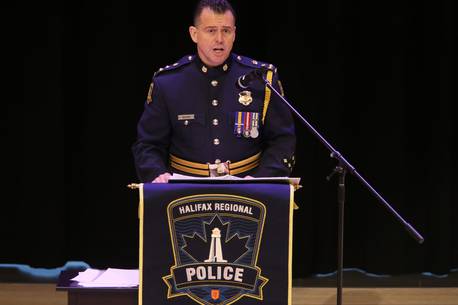
The composition of a long-anticipated survey to measure public satisfaction with police services in Halifax Regional Municipality will be brought to the police commission at Monday’s meeting.
Narrative Research, formerly known as Corporate Research Associates, has prepared a template of what the survey objectives ought to be and the method to achieve those objectives.
Narrative, which has been involved in research with the Halifax Regional Police, the RCMP Halifax District and the municipality, says it’s understood that the key research goals will be to measure citizens’ satisfaction with municipal policing, to determine perceptions of police service providers, to assess residents’ perceptions of police service priorities, understand how those perceptions vary across the municipality and among key diverse audiences and to ensure key measures are established that provide a benchmark for regular tracking of performance.
One perception that has come through loud and clear since the delivery last March of the Wortley report on street checks is that the black community of Halifax is often not satisfied with how they are treated by police.
“I want to address some concerns from the African Nova Scotia community around continuing to increase the police budget when we have had no action on the demands of the black community,” activist El Jones said last week when members of the public were given an opportunity to speak to council before the dual HRP-RCMP budget requests were discussed.
“To reiterate, DEPAD, Decade of Persons of African Descent Coalition, has made these demands very clear,” Jones said. “We have asked for action on traffic stops, we have had no transparency on that data and we have not got that despite that being the inciting incident in the Kirk Johson case. We have a very narrow definition of street checks eventually dealt with and we still have not dealt with all the traffic stops.
“We still have concerns about the use of our data and what is happening with our data. We still have not had clarity on that.”
In his report, Toronto criminologist Scot Wortley found that African Nova Scotians were six times more likely than whites to be street checked in HRM.
“Street checks have contributed to the criminalization of black youth, eroded trust in law enforcement and undermined the perceived legitimacy of the entire criminal justice system,” Wortley said in his report, recommending that the practice be banned outright or strictly regulated.
The practice was eventually banned province-wide as former chief justice Michael MacDonald submitted a legal opinion that the practice was not legal and Halifax Police Chief Dan Kinsella delivered a public apology to the black community.
“I am sorry for our actions that caused you pain,” Dan Kinsella told an audience of more than 125 people at a Halifax Central Library auditorium in late November.
“I am sorry for all those times you were mistreated, victimized and revictimized. While decades of injustices cannot be undone, we are committed to doing better moving forward. My hope is that today’s apology shows you our commitment to change and our promise to do better.”
But Jones told regional council last week that little has changed.
“A week after the police apology, we saw the tazing of a black man on Quinpool (Road) followed by, six weeks ater the apology, the now quite infamous case of Santino Rao in the WalMart who was beaten by six cops,” Jones said. “She is still charged and those charges are coming into court Feb. 19. At this time, we are still seeing acts of police brutality, we’re still seeing acts of police profiling and there are major concerns not only about the police force but also the oversight mechanism (Serious Incident Response Team).”
“We’ve been very clear that we’ve developed an African Nova Scotia policing strategy and we have not seen that implemented and we have not seen meaningful consultation on that to this date,” Jones said.
The proposed first phase of the survey process would consist of professionally moderated discussions with groups of 15 to 20 members of the public in a public space such as a library. The discussion would identify factors to be measured that are most important to the public in terms of satisfaction with the police service.
The second phase of the survey, guided by the first-phase discussion, would consist of telephone and online surveys. The telephone survey would be conducted among a random sample of 400 citizens and the online survey would be publicly accessible on the HRM website, with the hope of engaging as many people as possible.
Each survey is expected to take participants 8-10 minutes to complete. The public survey about police has been talked about for nearly five years.







