

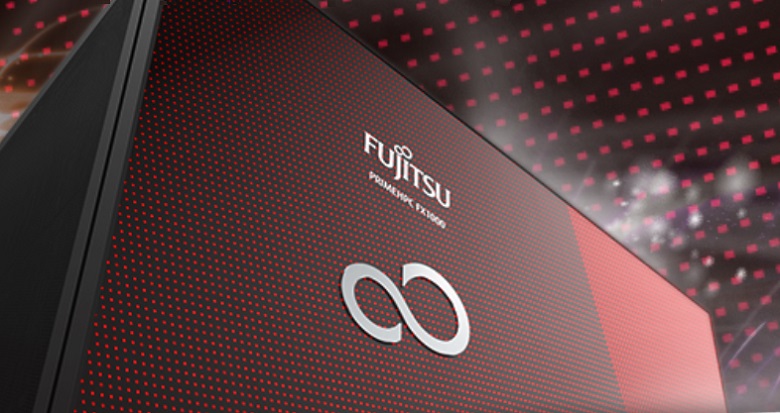
Japanese tech giant Fujitsu announced today that it will supply Nagoya University Information Technology Center with the first commercial supercomputer powered by the Arm64FX technology developed for RIKEN’s “Fugaku” (formerly post-K) supercomputer. The new system will be comprised of 2,304 Fujitsu PRIMEHPC FX1000 nodes, offering a theoretical peak performance of 7.782 petaflops and a total main memory capacity of 72 terabytes.

The Arm-based PRIMEHPC FX1000 system, housed in six racks, will be located with an Intel-based PRIMERGY CX2570 M5 subsystem, sporting 2nd Gen Intel Xeon Scalable processors and Nvidia V100 GPUs, that will provide another 7.489 theoretical petaflops with 82 terabytes of main memory. A third smaller system, comprising HPE SuperdomeFlex servers, adds another 77.41 peak teraflops. And a final private cloud system encompassing HPE ProLiant DL560 components managed by Fujitsu’s UNCAI Technical Computing Solution provides 537.6 theoretical teraflops. In aggregate, the theoretical performance offered by these four systems reaches 15.88 petaflops.
As part of the Joint Usage/Research Center for Interdisciplinary Large-scale Information Infrastructures (JHPCN), Nagoya University Information Technology Center is tasked with providing computational resources across Japan for both public and private use. The new hardware is expected to be put into production in July 2020, according to Fujitsu.
 The center is upgrading from its current system, a Fujitsu PRIMEHPC FX100 cluster of 2,880 nodes that delivers 3.2 peak petaflops (2.9 Linpack petaflops). The planned refresh, providing a 4-5X boost in computing capacity, is being deployed to keep pace with the demand from researchers engaged in modeling and simulation as well to satisfy the influx of data science workloads across Japan. Target applications draw on both traditional HPC and AI capabilities and include improved medical diagnostic and drug treatments, autonomous driving technology, and numerical simulation of weather events, such as typhoons, earthquakes and tsunamis.
 Kensaku Mori, director, Information Technology Center, Nagoya University commented on the ever-increasing demand for computing, noting that the supercomputer will tackle challenges closely related to the safety and security of people’s lives. “The data that is consumed and generated in computing, the networks that connect them, and the visualization for knowledge discovery from computing and data are [all] important,” he said.
Storage components include an SFA18KE parallel file system provided by Data Direct Networks Japan Co., Ltd. as well as the Fujitsu Exabyte File System (FEFS), Fujitsu’s large capacity, high performance distributed file system. Together they provide 30 petabytes. A 6-petabyte optical disc archive, made by Sony Corporation, provides low power consumption, long-term retention of recorded data, and high durability for research data.
Fujitsu, which is working closely with RIKEN on standing up the Fuguaku system for startup in 2020-2021, is one of two suppliers of Arm64FX-based systems. As revealed in November, in partnership with Fujitsu, Cray (now part of HPE) will also be bringing Arm64FX supercomputers to market in 2020 as part of their CS500 lineup. Cray, which said its systems will debut in mid-2020, has lined up a number of customers, including Stony Brook University, RIKEN Center for Computational Science, Oak Ridge National Laboratory, Los Alamos National Laboratory, and the University of Bristol.
Fujitsu had indicated it would begin shipping its first commercial Arm64FX systems in March of this year. In addition to the liquid-cooled, Tofu-connected PRIMEHPC FX1000 nodes used in the Nagoya University system, Fujitsu also offers the smaller air-cooled, InfiniBand-equipped PRIMEHPC FX700 modules.

Noteworthy aspects of the A64FX are its high computational efficiency due to the high memory bandwidth of HBM2 as well as its power efficiency. A prototype Fugaku system, comprising 768 A64FX CPUs, was announced at SC19. Delivering 16.88 gigaflops-per-watt, micro-Fugaku as its been nicknamed debuted at the top of the Green500 list. It entered the Top500 at no. 159 with a Linpack score of 2 petaflops out of 2.36 theoretical petaflops, realizing 84.75 percent Linpack efficiency.
On the occasion of setting the new energy-efficiency benchmark, Naoki Shinjo, Corporate Executive Officer, Fujitsu Limited, remarked that having the highest energy efficiency was one of the three major development goals of the Fugaku supercomputer along with high application performance and user-friendliness.







