

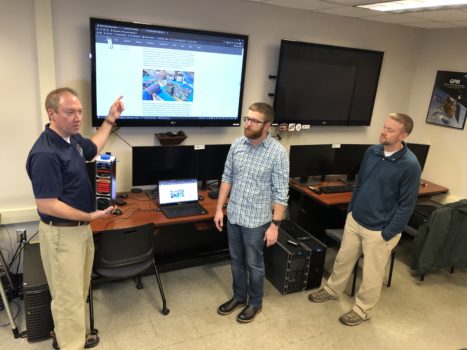
PLEASANT VALLEY, W.Va. — The NASA’s Independent Verification and Validation (IV&V) Program team of scientists and engineers who built West Virginia’s first spacecraft, Simulation to Flight-1 (STF-1) say the mission “exceeded expectations.”
 The CubeSat has been up for more than a year.
“STF-1 successfully operated more than 200 days in lower-earth orbit, compared to the 90-day average for most CubeSat or small satellite missions.” TMC Chief Engineer and Program Manager Scott Zemerick said Thursday referring to the March 2019 NASA Ames Research Center study titled, “Small-Satellite Mission Failure Rates.”
According to the study, from 2000-2016, 41.3% of all small satellites launched experienced total or partial mission failure. Of these, 6.1% were launch vehicle failures, 11% were partial mission failures, and 24.2% were total mission failures.
The STF-1 completed over approximately 5,500 orbits successfully transmitting more than 3.4 gigabytes of scientific payload experiment data on its four experiments that West Virginia University developed for the CubeSat mission. The experiments were all successfully executed multiple times.
WVU was the research partner of the STF-1 mission. The four science experiments WVU developed included a low-powered characterizer of III-V Nitride based materials, a Microelectromechanical System (MEMS) Inertial Measurement Unit (IMU) swarm, the testing of a Global Navigation Satellite System (GNSS) Receiver for precise orbit determination, and an environment and space weather investigation which was split into two separate experiments lead by Dr. Dimitris Vassiliadis worked as a research associate professor in the WVU Physics Department at the early stages of the STF-1 mission.
 Scott Zemerick
“STF-1 was quite successful in operating nearly flawlessly in terms of spacecraft performance for about 6 months and also meeting several science goals including those pertaining to the plasma experiment and the energetic-particle experiment,” Vassiliadis said. “This is somewhat remarkable for a CubeSat built by a first-time team with varying levels of expertise, but it is one more demonstration that modern CubeSats are becoming increasingly reliable.”
According to Vassiliadis, the plasma experiment recorded the abundance of two types of low-energy particles in the ionospheric plasma which enabled the team to obtain estimates for the plasma density and temperature from these data.
“In the second experiment, two Geiger counters were used to measure kilovolt-energy particles, most probably electrons precipitating from the magnetosphere, a vast teardrop-shaped region surrounding the ionosphere,” Dr. Vassiliadis added. “Taking these measurements was the primary goal of each one of the two experiments with data analysis and conclusions about space weather conditions being a second goal.
Several of these results were presented at the American Geophysical Union Fall 2019 meeting held recently in San Francisco, CA. A big part of the STF-1 mission’s success was the use of a unique simulation software that the NASA IV&V and TMC team developed. The software, named the NASA Operation Simulator for Small Satellites (NOS3) NOS3’s success was even recognized by NASA’s Inventions and Contributions Board who named the modeling and simulation technology the NASA 2019 Software of the Year Runner Up.
West Virginia’s first spacecraft launched into orbit at 1:33 a.m. on Dec. 16, 2018 on the first ever NASA Venture Class Launch Services mission via the Rocket Lab Electron Rocket. The launch took place from New Zealand’s Mahia Peninsula, and STF-1 was one of several CubeSats deployed by the California-based Rocket Lab’s Electron vehicle as part of NASA’s Educational Launch of Nanosatellites (ELaNa-19) mission.
The STF-1 program began in 2015 when the project was selected for participation in NASA’s CubeSat Launch Initiative. The CubeSat was built thanks to a collaboration between NASA’s IV&V Program, located at the Katherine Johnson IV&V Facility, West Virginia University, the NASA West Virginia Space Grant Consortium, West Virginia High Tech Foundation and TMC.
Today, the STF-1 team is forming new research partnerships in hopes of building West Virginia’s second spacecraft.
“We’ve already held preliminary meetings with several high-profile academic, engineering and research institutions in West Virginia and around the nation,” Zemerick said. “We are very optimistic a Simulation to Flight-2 will come to fruition.”







