

, Sandeep Shastri, Sanjay Kumar
| New Delhi |
Updated: December 14, 2019 7:12:04 am
 While it is noteworthy that Kejriwal’s popularity appears a little more than Modi’s, this may be because respondents were aware of the context — this survey was about Delhi, rather than national-level politics.
Six years ago, the Aam Aadmi Party came into being as an experiment — it is not often that an agitation transforms itself into a political party, but the anti-corruption agitation of 2011-12 did just that. Its first brush with power left many in doubt about the AAP’s ability to move beyond its maverick and adversarial image and entrench itself into a party that could govern. Even after securing 67 of 70 seats in Delhi Assembly, its top leadership briefly flirted with the image of ‘fighters’ — taking on the BJP and the PM on various issues. Soon, it tamed itself, and probably with good results.
Residents of Delhi may not be interested in criticisms of Prime Minister Narendra Modi, but they also do not seem to be in the mood to remove AAP from power, an opinion survey among 2,298 Delhi voters, conducted by the Lokniti programme of the Centre for the Study of Developing Societies, suggests.
Through this week, key findings from the survey showed that the AAP government, according to most Delhi residents, has fared well on fronts of education, health and transport.
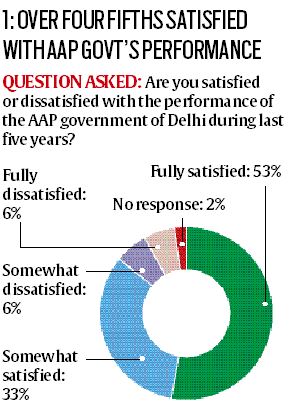
As of early December, the AAP government enjoys a fair amount of voter satisfaction (table 1) — for almost every nine respondents who are very satisfied with it, there is only one very dissatisfied.
Moreover, respondents expressed satisfaction about the performance of their MLAs, indicating that the party has gained sufficient goodwill on the basis of its work, programmes and promises. In addition, the party also has the advantage of Chief Minister Arvind Kejriwal’s continued acceptability among voters in Delhi. While more than two thirds of the respondents said they like Kejriwal very much, only 4% disliked him very much (table 2).

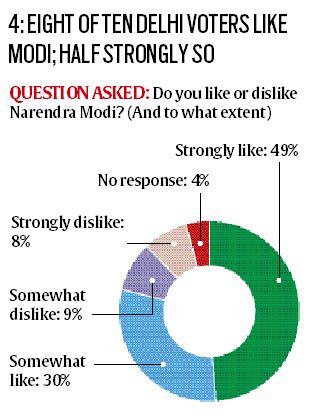
Does the BJP, then, stand a chance to dent the popularity of AAP? In terms of personal popularity, Modi is certainly popular among Delhi voters: half the respondents said they strongly liked Modi with another 30% saying they liked Modi (table 4). While it is noteworthy that Kejriwal’s popularity appears a little more than Modi’s, this may be because respondents were aware of the context — this survey was about Delhi, rather than national-level politics. That is why, when voters were asked to choose, 42% chose Kejriwal over Modi, and 32% chose Modi over Kejriwal.
That said, three in every four voters are quite satisfied with the Modi government. But for as many as 20% respondents, unemployment, price rise and other economic concerns will be main voting issues. Among such voters, the net satisfaction with the Modi government’s performance was found to be only 43%, the lowest across all answer categories.

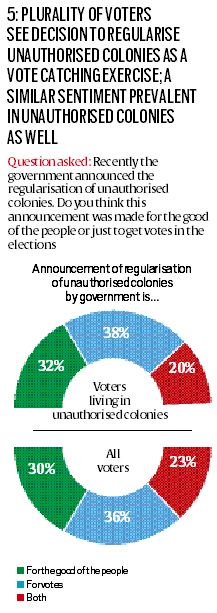
To dent the AAP, the BJP-led central government recently announced its decision to regularise unauthorised colonies in the city. The survey, conducted before the passage of the regularisation/ownership Bill in Lok Sabha but after the announcement had been made, found that most voters had a mixed opinion on the issue (table 5). Voters were not sure if this decision is only for the purpose of winning votes or if it is a genuine gesture. Moreover, most voters were not sure if the government will be able to implement it. Most interestingly, when it came to giving credit for the decision, 49% of the voters, even those living in unauthorised colonies (47%), said it had been taken by the Delhi government.
With elections at least a month or two away, these findings cannot claim any finality as to likely trends. Nevertheless, there are some key takeaways. One, in voters’ perception, the Delhi government has done well. Two, though voters are not particularly dissatisfied with BJP’s central government, they may well opt for an alternative during the assembly polls. Three, Delhi presents a peculiar case of multiple levels of governmental power being exercised — and voters expect better coordination among the different levels.
But above all, as we conclude this report that appeared following the 43 deaths due to a fire, the single biggest takeaway might be this: AAP seems to have delivered on delivery and redistribution, but what worth is governance, if it fails on the basic regulatory function of government? In the political one-upmanship and possible face-off between Kejriwal’s AAP and Modi’s BJP, this nagging fact needs to be remembered beyond elections and beyond parties.
HOW THE SURVEY WAS CONDUCTED
The findings presented here are from a survey conducted in Delhi by the Lokniti programme of the Centre for the Study of Developing Societies (CSDS). The survey was conducted from November 22 through December 3, 2019 among 2,298 voters in 115 locations (polling stations) spread across 23 Assembly Constituencies of the capital. The sampling design adopted was multi-stage random sampling. The Assembly Constituencies were randomly selected using the probability proportional to size method.
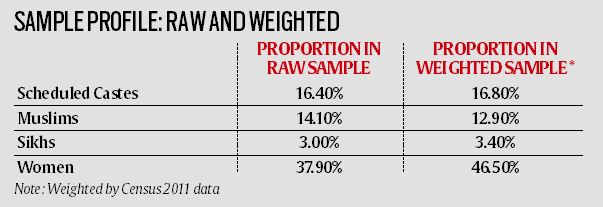
Thereafter, five polling stations within each of the sampled constituencies were selected using the systematic random sampling method. Nearly 50 trained field investigators conducted face-to-face interviews of the respondents in Hindi asking them a set of standardised questions on mostly governance-related matters. The interviews were conducted at every fifth house of a polling station in order to ensure randomness. The interview duration was about 30 minutes on average. In order to ensure representativeness and correct for underrepresentation of key demographics, the achieved raw sample has been weighted by Gender, Religion, and Caste group based on Census 2011 data. All analysis here has been presented on the weighted data set. The survey was designed, supervised and analysed by a team of researchers associated with Lokniti. They include Shreyas Sardesai, Biswajit Mohanty, Himanshu Bhattarcharya, Manjesh Rana, Dhananjay Kumar Singh, Vibha Attri, Jyoti Mishra, Sakshi Khemani, Aditya Pandey, Neel Madhav, Fakru Zzaman, Deepti Mary Minj, Muzamil Yaqoob and Jagannath Kashyap. Prof. Suhas Palshikar and Prof. Sandeep Shastri guided the research team in analysing the data and with the write-ups. The survey was directed by Prof. Sanjay Kumar of CSDS. Lokniti would like to acknowledge the support of Durba Chattaraj of Ashoka University who partially supported this survey with the Franklin Research Grant of the American Philosophical Society.
(Suhas Palshikar is the Co-director of the Lokniti programme of the Centre for the Study of Developing Societies and the chief editor of ‘Studies in Indian Politics’. Sanjay Kumar is the Director of the CSDS and the Co-director of Lokniti. Sandeep Shastri is the Pro Vice Chancellor of Jain University, Bengaluru and the National Co-ordinator of the Lokniti network.)
For all the latest Delhi News, download Indian Express App







