

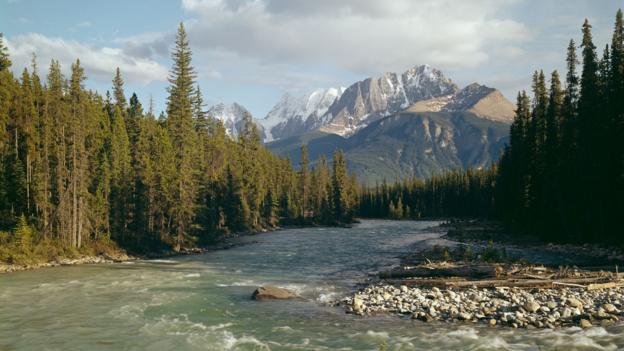
Salmon populations are facing pressure from multiple stressors including climate change, pollution, fisheries, habitat degradation and habitat loss across the Pacific coast. While many salmon populations on the Central Coast of British Columbia are healthy, others are depressed, declining, or of conservation concern. The status of about 70% of the salmon populations here is unknown. But many streams here are healthy, making it an excellent natural laboratory.
Dennert’s work builds on a slowly accumulating understanding of how salmon feed the land. Salmon biologist Tom Quinn at the University of Washington, Seattle, and colleagues including his then graduate student Rachel Hovel, now at the University of Maine, Farmington, conducted an elegant if somewhat accidental experiment published in 2018. During sockeye surveys on Hansen Creek, southwestern Alaska, “we would walk up the stream and count the salmon,” says Hovel, noting cause of death, then throwing carcasses to one bank. Twenty years of this lop-sided tossing created an opportunity to test nutrient enrichment. Comparing growth and nitrogen content in spruce trees on the stream’s north and south sides, they found a signal indicating that salmon indeed fed and sped up tree growth.
Dennert’s doctoral supervisor John Reynolds, an aquatic ecologist at Simon Fraser University, also previously examined how plants respond to salmon streams. Reynolds partnered with the Heiltsuk Nation to survey salmon and plants on fifty watersheds on the Central Coast. Hugging over 6,000 trees to measure their diameters, they found a strong correlation between streams with more salmon and nutrient-loving plants and trees.
Other work has shown that flowers can coordinate their blooms with the arrival of salmon, helpful for their pollinators that might eat their decaying remains, too.
Because much of the previous work was correlational, the Reynolds lab began experimenting. Starting on a Central Coast stream that salmon couldn’t access because of a waterfall, Reynolds and Hocking set up experimental sites. It involved hauling heavy dead chum salmon “in dripping green garbage bags” through prime grizzly habitat so they could see what would happen to the vegetation at the site if the fish were left there. On 11 streams, their experiment showed that plants draw nitrogen from salmon in spring, many months after carcasses are deposited.
Dennert is still collecting data, plant by plant, bug by bug, flower by flower, and much of her analysis is yet to come. Preliminary results suggest that some plants fed by salmon, like yarrow and aster, have bigger flowers, with bigger leaves. Those bigger flowers may attract more pollinators, helping diversity to flourish. And there are hints that if salmon disappear from some of these streams – perhaps never to return – the diverse communities that depend on them will be poorer.







