
GLOBAL RESEARCH SYNDICATE
No Result
View All Result
  • Login
  • Latest News
  • Consumer Research
  • Survey Research
  • Marketing Research
  • Industry Research
  • Data Collection
  • More
    • Data Analysis
    • Market Insights
  • Latest News
  • Consumer Research
  • Survey Research
  • Marketing Research
  • Industry Research
  • Data Collection
  • More
    • Data Analysis
    • Market Insights
No Result
View All Result
globalresearchsyndicate
No Result
View All Result
Home Data Collection

This Is What The Galactic Centre Would Look Like if We Could See in Radio Wavelengths

globalresearchsyndicate by globalresearchsyndicate
November 22, 2019
in Data Collection
0
This Is What The Galactic Centre Would Look Like if We Could See in Radio Wavelengths
0
SHARES
5
VIEWS
Share on FacebookShare on Twitter

The most in-depth radio survey ever taken of the southern sky has helped astronomers find the remnants of dead massive stars nobody knew were there. It’s also produced some gorgeous images in the process.


It’s called GaLactic and Extragalactic All-sky MWA (GLEAM), an all-sky survey with the same resolution as the human eye – showing what the sky would look like if you could see it in radio wavelengths.

At radio wavelengths between 72 and 231 megahertz, the survey shows a whole passel o’ things that are usually invisible.

“It’s the power of this wide frequency range that makes it possible for us to disentangle different overlapping objects as we look toward the complexity of the Galactic Centre,” said astrophysicist Natasha Hurley-Walker of the International Centre for Radio Astronomy Research (ICRAR) node at Curtin University, Australia.

“Essentially, different objects have different ‘radio colours’, so we can use them to work out what kind of physics is at play.”

The orange streak in the middle of the image (above) is the galactic plane and galactic centre, glowing brightly due to synchrotron radiation – electrons being accelerated along spiralling magnetic field lines. The blue is where red light is being blocked, for example by the plasma around stars. You can explore an interactive website here for a closer look.


Those bubble-shaped blobs are supernova remnants, left behind expanding into space after a star has exploded. The high-energy electrons that produce synchrotron radiation are thought to be produced by these supernova remnants; but to account for all the synchrotron radiation we see, there would need to be more supernova remnants out there than astronomers have discovered so far.

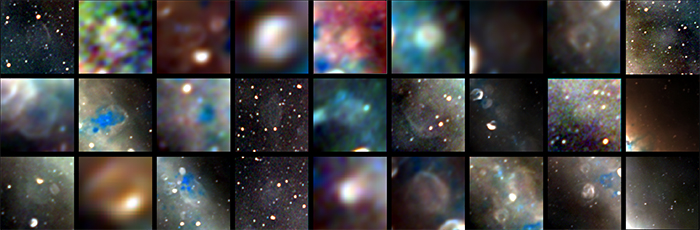
So, Hurley-Walker and her team conducted an investigation using the latest GLEAM data release to try and find these missing explosions. Younger and closer supernova remnants, or those in densely populated regions, are much easier to find – astronomers know of 295 of them – so the team looked farther away, and in regions that are relatively empty.
(Natasha Hurley-Walker/ICRAR/Curtin/GLEAM Team)(Natasha Hurley-Walker/ICRAR/Curtin/GLEAM Team)

They found 27 previously unknown supernova remnants from massive stars, over eight times the mass of the Sun.

In one particularly empty region of sky, where supernova remnants are really faint, they even found a really young one.

“It’s the remains of a star that died less than 9,000 years ago, meaning the explosion could have been visible to Indigenous people across Australia at that time,” Hurley-Walker said.

We know that Indigenous Australians have a rich history of astronomy dating back 65,000 years, and their oral traditions often feature stars that vary in brightness. It’s possible this supernova could be described in these traditions, although this is yet to be investigated.
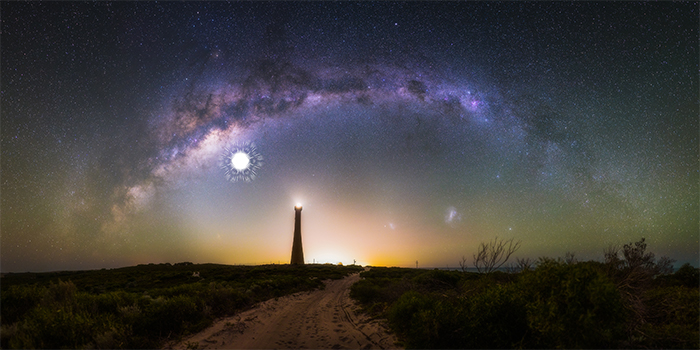
Where the supernova would have appeared 9,000 years ago. (Paean Ng/Astrordinary Imaging)Where the supernova would have appeared 9,000 years ago. (Paean Ng/Astrordinary Imaging)

Two of the other remnants identified appear in regions of the sky that have no massive stars, which means it’s possible these previously overlooked regions may be a source of hidden dead stars. Others still were particularly old – an exciting find, because supernovae in this age range are very difficult to spot.

The Murchison Widefield Array, the radio telescope in the Australian desert used to conduct the observations, is one of the few radio observatories in a “stable western country” that can observe in frequencies between 80 and 300 megahertz without significant interference.

It’s also recently received a significant upgrade. This means, the researchers wrote in their paper, there could be even more supernova remnants that can be found using the GLEAM survey, just waiting to be discovered.

The research has been published in the Publications of the Astronomical Society of Australia.

 

Related Posts

How Machine Learning has impacted Consumer Behaviour and Analysis
Consumer Research

How Machine Learning has impacted Consumer Behaviour and Analysis

January 4, 2024
Market Research The Ultimate Weapon for Business Success
Consumer Research

Market Research: The Ultimate Weapon for Business Success

June 22, 2023
Unveiling the Hidden Power of Market Research A Game Changer
Consumer Research

Unveiling the Hidden Power of Market Research: A Game Changer

June 2, 2023
7 Secrets of Market Research Gurus That Will Blow Your Mind
Consumer Research

7 Secrets of Market Research Gurus That Will Blow Your Mind

May 8, 2023
The Shocking Truth About Market Research Revealed!
Consumer Research

The Shocking Truth About Market Research: Revealed!

April 25, 2023
market research, primary research, secondary research, market research trends, market research news,
Consumer Research

Quantitative vs. Qualitative Research. How to choose the Right Research Method for Your Business Needs

March 14, 2023
Next Post
Global Packaged Burgers Market 2019-2023 | Evolving Opportunities with Beyond Meat Inc. & BUBBA foods LLC

Global Packaged Burgers Market 2019-2023 | Evolving Opportunities with Beyond Meat Inc. & BUBBA foods LLC

Categories

  • Consumer Research
  • Data Analysis
  • Data Collection
  • Industry Research
  • Latest News
  • Market Insights
  • Marketing Research
  • Survey Research
  • Uncategorized

Recent Posts

  • Ipsos Revolutionizes the Global Market Research Landscape
  • How Machine Learning has impacted Consumer Behaviour and Analysis
  • Market Research: The Ultimate Weapon for Business Success
  • Privacy Policy
  • Terms of Use
  • Antispam
  • DMCA

Copyright © 2024 Globalresearchsyndicate.com

Welcome Back!

Login to your account below

Forgotten Password?

Retrieve your password

Please enter your username or email address to reset your password.

Log In
This website uses cookies to improve your experience. We'll assume you're ok with this, but you can opt-out if you wish. Cookie settingsACCEPT
Privacy & Cookies Policy

Privacy Overview

This website uses cookies to improve your experience while you navigate through the website. Out of these cookies, the cookies that are categorized as necessary are stored on your browser as they are essential for the working of basic functionalities of the website. We also use third-party cookies that help us analyze and understand how you use this website. These cookies will be stored in your browser only with your consent. You also have the option to opt-out of these cookies. But opting out of some of these cookies may have an effect on your browsing experience.
Necessary
Always Enabled
Necessary cookies are absolutely essential for the website to function properly. This category only includes cookies that ensures basic functionalities and security features of the website. These cookies do not store any personal information.
Non-necessary
Any cookies that may not be particularly necessary for the website to function and is used specifically to collect user personal data via analytics, ads, other embedded contents are termed as non-necessary cookies. It is mandatory to procure user consent prior to running these cookies on your website.
SAVE & ACCEPT
No Result
View All Result
  • Latest News
  • Consumer Research
  • Survey Research
  • Marketing Research
  • Industry Research
  • Data Collection
  • More
    • Data Analysis
    • Market Insights

Copyright © 2024 Globalresearchsyndicate.com




